Labor law
Guides on German residence permits, citizenship, work, and family law — in your language. Each article points to official statutes and is not a substitute for qualified legal advice.
10 results
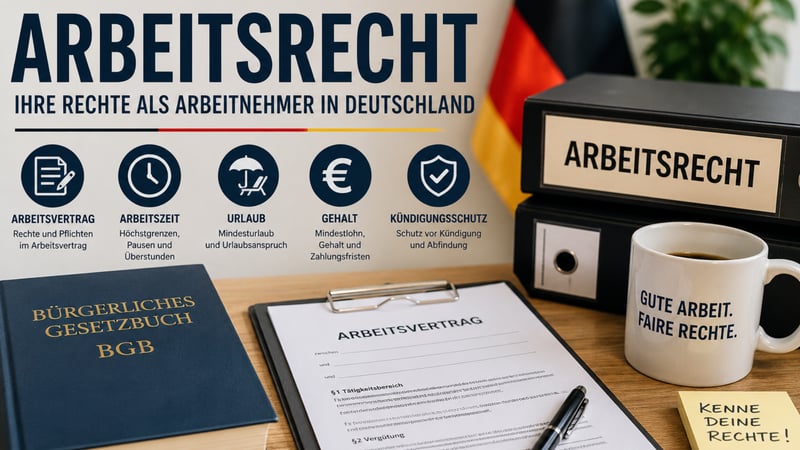
Employment Contracts, Employee Rights, Working Hours, and Important Workplace Regulations ⸻ Introduction Many immigrants entering the German job market are not fully familiar with the country’s labor laws at the beginning of their journey. This sometimes leads to misunderstandings, workplace problems, or even exploitation. In Germany, labor law is not only about monthly salary. Issues such as: employment contracts, working hours, vacation, sick leave, dismissal from work, overtime, job security, and the relationship between employer and employee are all regulated by specific laws. The purpose of German labor law is to create a balance between: the rights of employers, the job security of employees, and order within the workplace. This article is a general introduction to the most important principles of labor law in Germany. In future articles, each topic will be explained separately and in greater detail. ⸻ Employment Contracts (Arbeitsvertrag) in Germany In most jobs, the working relationship between employer and employee is regulated through an: employment contract. This contract usually includes: type of work, salary, working hours, number of vacation days, duration of the contract, probation period (Probezeit), and conditions for terminating the contract. ⸻ Are verbal contracts legally valid? In many cases: Yes. Even if there is no written contract, an employment relationship may still be legally valid. However, having a written contract is extremely important because in the event of disputes, proving: salary, working hours, or employee rights can become much more difficult without written documentation. ⸻ Probation Period (Probezeit) In many employment contracts, the first few months are considered the: probation period. Typically, the probation period can last up to: 6 months, although it may be shortened by agreement between both parties. One important feature of the probation period is that both the employer and employee can usually terminate the contract more easily during this time. ⸻ Working Hours in Germany German law sets clear limits on working hours. ⸻ Important Legal Provision § 3 Arbeitszeitgesetz (ArbZG) German Legal Text „Die werktägliche Arbeitszeit der Arbeitnehmer darf acht Stunden nicht überschreiten.“ ⸻ Translation “The daily working time of employees may not exceed eight hours.” ⸻ Simple Explanation In many professions: the standard working day is 8 hours. However, under certain conditions: legal overtime may be allowed, provided that rest periods and average working time regulations are respected. ⸻ Breaks and Rest Periods (Pause) In Germany, employees working long shifts are entitled to: breaks (Pause). Employers are legally required to follow regulations regarding: rest periods, and working time limits. ⸻ Minimum Wage (Mindestlohn) in Germany Germany has a: legal minimum wage. Employers generally may not pay less than the legally established minimum wage, except in certain specific legal situations. The minimum wage may change every year. ⸻ Vacation Leave (Urlaub) in Germany Employees in Germany are entitled to: paid vacation leave. Under German law, many employees receive: at least 20 working days of vacation per year, while many companies provide even more vacation days. ⸻ Sick Leave and Illness If an employee becomes ill: they must inform the employer, and in some cases provide a medical certificate. In many situations, employees continue receiving their salary while on sick leave. ⸻ Dismissal from Work (Kündigung) in Germany In Germany, dismissal from work is not always immediate or unrestricted. Many employees are protected by labor laws, and employers must follow specific legal procedures. ⸻ Very Important Note If someone receives a: Kündigung (termination letter), they usually need to act quickly. In many cases, there are only: 3 weeks to file a legal objection. ⸻ Can an employer assign work outside the contract? This is one of the most common questions among immigrants. In some situations, employers may assign: related, reasonable, and job-appropriate tasks to employees. For example: if someone is employed as an electrician, they may also be asked to: organize tools, clean their work area, or keep the workspace tidy. These duties are generally considered normal. ⸻ But where is the legal limit? An employer may not: constantly force completely unrelated tasks, humiliate employees, or abuse their position. For example: forcing an electrician to clean the company’s public restroom every day after work could become legally problematic. ⸻ Overtime (Überstunden) Many immigrants believe overtime is always mandatory. However: overtime conditions must be legal, and in many cases overtime must be compensated: either financially, or with additional time off. ⸻ Discrimination in the Workplace In Germany, discrimination based on: race, religion, gender, or ethnicity is illegal. Employees have the right to work in a safe and respectful environment. If discriminatory behavior occurs, whether from: the employer, or other coworkers, the affected employee has the right to: object, and in some situations even file a legal complaint. ⸻ Common Mistakes Made by Immigrants Some immigrants: sign contracts without reading them, are unaware of their legal rights, or fail to document working hours and overtime. This can sometimes lead to workplace problems or exploitation. ⸻ Important Warning In Germany: employment contracts, health insurance, tax payments, and legal work registration are extremely important. Otherwise, illegal employment: Schwarzarbeit may be assumed and can create serious legal problems for both: the employee, and the employer. For immigrants, in addition to financial penalties, it may also negatively affect: residence permits, and insurance status. ⸻ Understanding Your Contract Since employment contracts in Germany are usually written in German, immigrants who are not sufficiently fluent in the language should ideally: translate the contract before signing, or seek help from a trusted translator or legal expert, so they fully understand the agreement they are about to sign. ⸻ Final Conclusion To build a safe and stable working life in Germany: ✔ Read your employment contract carefully ✔ Know your legal rights ✔ Keep records of working hours and overtime ✔ Take taxes and insurance seriously ✔ Act quickly if workplace problems arise In Germany, understanding labor law is not only about avoiding problems — it also helps people work and live with greater security, confidence, and awareness. ⸻ ✔ Awareness ✔ Responsibility ✔ Knowledge of legal rights These three principles are the foundation of professional and workplace success in Germany.
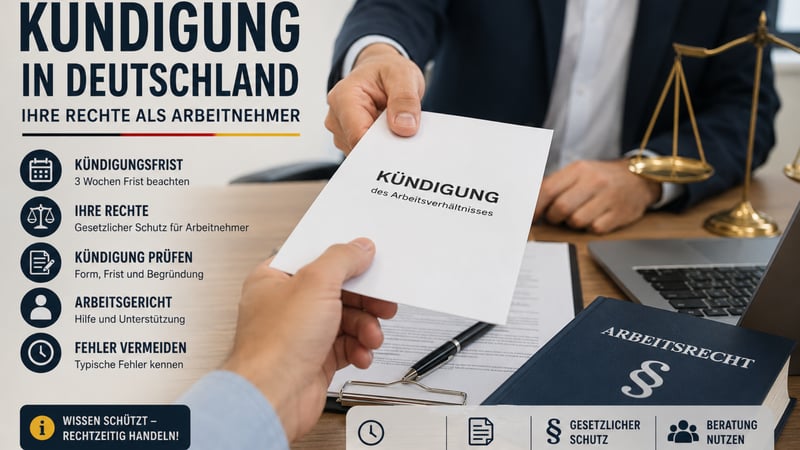
Employee Rights, Deadlines for Objection, and Important Legal Mistakes ⸻ Introduction For many immigrants working in Germany, receiving a termination letter — known as a Kündigung — is one of the most stressful events in their working life. Some people believe that in Germany an employer can terminate an employee at any time and without reason. In reality, however, German labor law protects employees in many situations, and employers are required to follow specific legal rules and procedures. At the same time, many immigrants lose their opportunity to object because they are unaware of the law, sign incorrect documents, or face financial and residency problems without knowing their rights. This article is a simple and practical guide about the conditions and rules for ending an employment relationship in Germany. ⸻ What is a Kündigung? A Kündigung is an official written notice that ends an employment relationship. This termination may come: from the employer, or from the employee. However, both parties must follow the conditions stated in the employment contract, provided those conditions do not conflict with German law. For example: If the employment contract signed by both parties states that the employee must provide written notice 4 weeks before the intended end date of employment, the employee cannot simply choose a termination date only 2 weeks away — except in certain special situations explained later in this text. ⸻ Types of Termination in Germany In Germany there are several main types of Kündigung: 1. Ordentliche Kündigung Ordinary termination with the legally required notice period. 2. Fristlose Kündigung Immediate termination without observing the legal or contractual notice period. 3. Aufhebungsvertrag A mutual agreement between both parties to end the employment relationship. ⸻ Question: Can an employment contract be terminated verbally? Usually no. In Germany, a Kündigung must be written and official. This means that a WhatsApp message, phone call, email, or verbal dismissal alone is generally not sufficient. The party requesting termination must provide a written letter including signature, date, and formal notice of termination. ⸻ Important Legal Provision § 623 BGB – Written Form of Termination Text of the Law „Die Beendigung von Arbeitsverhältnissen durch Kündigung oder Auflösungsvertrag bedarf zu ihrer Wirksamkeit der Schriftform.“ ⸻ Translation “The termination of employment relationships through dismissal or termination agreement requires written form in order to be legally valid.” ⸻ Probation Period (Probezeit) and Dismissal In many employment contracts, the first few months are considered a Probezeit (probation period). During this period, ending the employment relationship is usually easier, and the notice period is shorter. However, even during probation, certain protective laws and anti-discrimination rules still apply. ⸻ The Most Common Mistake Among Immigrants Some people believe: “Because I am in Probezeit, I have no rights.” This assumption is completely wrong. The law still protects employees, and if you disagree with the termination by the employer, you still have the right to object. ⸻ Deadline to Challenge a Dismissal Very important: If a person receives a Kündigung, they usually have only 3 weeks to file an objection at the Arbeitsgericht (Labor Court). If this deadline is missed, even an unlawful dismissal may later be considered legally valid. ⸻ Example Imagine that: your employer dismisses you without a valid reason, but you put the letter aside or react too late. After the legal deadline expires, challenging the dismissal becomes much more difficult. You would then need a convincing reason explaining why you failed to act on time; otherwise, the chances of your case being reviewed become very low. Examples of convincing reasons include: serious illness and hospitalization, death of close family members, or similar exceptional situations. ⸻ Does the Employer Have to Explain the Reason for Dismissal? Yes. Especially in larger companies where the Kündigungsschutzgesetz (KSchG) — the Protection Against Dismissal Act — applies. ⸻ What is a Fristlose Kündigung? A Fristlose Kündigung means immediate termination, where the employer claims that continuing the employment relationship is no longer acceptable. For example: If the employer can prove theft, violence, threats, serious insults, fraud, or major violations of company rules by the employee, they may terminate employment very quickly. In some situations, the employer may terminate the contract without respecting the ordinary notice period. However, this still must comply with the law and can still be challenged in court. ⸻ Can Illness Lead to Dismissal? Many immigrants fear this issue and therefore try to continue working even while sick. However, in Germany there is a common saying: “Health comes first, then work.” This means that if you genuinely feel unwell, you may use sick leave. Short-term illness is generally not a sufficient reason for dismissal — unless the employer discovers that the illness was fake and the employee only pretended to be sick to avoid work. For example: An employee claims to be ill and unable to work, but it later becomes clear that the person was traveling and not actually sick. Another situation may occur if a person becomes permanently unable to continue working because of illness and can no longer perform as before. In such cases, termination may become possible. Otherwise, a few days of rest because of a cold or short-term illness is normally not a valid reason for dismissal. ⸻ Dismissal During Pregnancy In Germany, pregnant women enjoy very strong legal protection. Therefore, dismissal during pregnancy or shortly after childbirth is generally illegal. No employer may dismiss an employee simply because of pregnancy. ⸻ What is an Aufhebungsvertrag? Some employers suggest signing an Aufhebungsvertrag instead of issuing a Kündigung. This means ending the employment relationship through mutual agreement. ⸻ Important Warning Some immigrants sign such agreements without consultation. However, this may negatively affect unemployment benefits, residence status, or social benefits. Keep in mind: If the termination comes from the employer, you may apply for unemployment benefits through the employment office. Depending on your employment history and family situation, you may receive approximately 65% to 75% of your net salary for a period between 9 and 15 months. However, if the termination request comes from you, or if the contract ends through mutual agreement, unemployment benefits may be delayed or restricted. ⸻ What Should You Do After Receiving a Termination Letter? If you receive a Kündigung: ✔ Stay calm ✔ Record the date you received the letter ✔ Do not forget the 3-week deadline ✔ Do not sign anything without reading carefully ✔ If necessary, consult a lawyer or a Beratungsstelle (advisory center) You should also contact the Agentur für Arbeit to officially register your unemployment status and apply for possible social support. ⸻ Can Dismissal Affect Residence Status? For some immigrants: yes. Especially if the residence permit is tied to employment, or if the person remains unemployed for a long period. However, not every dismissal means losing your residence permit. ⸻ Discrimination and Unlawful Dismissal If a dismissal happens because of nationality, religion, gender, age, or other discriminatory reasons, it may be considered unlawful. ⸻ The Role of the Labor Court (Arbeitsgericht) The Arbeitsgericht is the specialized court for employment disputes in Germany. Many cases involving dismissals, salaries, overtime, and workplace disputes are handled there. ⸻ Dangerous Mistakes Made by Immigrants Some people ignore the Kündigung letter, react too late, or sign documents without fully understanding them. This can create serious legal problems. It is also important to know that signing confirmation of receipt of a termination letter does not necessarily mean accepting the dismissal itself. ⸻ Final Conclusion In Germany, losing a job does not always mean losing all employee rights. Many employees still have the right to object, receive legal protection, and pursue legal action. To protect your rights: ✔ Keep your employment contract ✔ Take official letters seriously ✔ Respect legal deadlines ✔ Do not sign anything without understanding it ✔ Seek advice quickly when necessary In Germany, knowing your labor rights can prevent many professional, financial, and even immigration-related problems.

Illegal Employment, Tax Evasion, Penalties, and Serious Risks for Migrants ⸻ Introduction Many migrants who newly arrive in Germany soon become familiar with the term Schwarzarbeit, meaning illegal or undeclared work. First, it is important to define what Schwarzarbeit actually means. Schwarzarbeit refers to work performed without legal registration. This means: working or employing someone without official declaration, without paying taxes, without insurance coverage, and without registration in Germany’s legal system. Some people think that if they do not pay taxes, work without a contract, or receive wages in cash, there is no major problem. However, in Germany, Schwarzarbeit is treated very seriously and can create severe legal problems for employees, employers, and even for the immigration status of migrants. Many migrants enter informal work without fully understanding the law, but later face financial penalties, insurance problems, loss of legal rights, or even risks to their residency status. This article is a simple and practical guide to the concept of Schwarzarbeit, the related laws, and its major risks in Germany. ⸻ Important Note About Zoll Inspections You should know that if officers from the German customs authority (Zoll), who are responsible for detecting illegal work, discover an undocumented worker at a workplace (meaning a worker without a legal employment contract), they may open legal cases against both the worker and the employer. This is based on: § 1 Schwarzarbeitsbekämpfungsgesetz (SchwarzArbG) Text of the Law „Schwarzarbeit leistet, wer Dienst- oder Werkleistungen erbringt oder ausführen lässt und dabei als Arbeitgeber, Unternehmer oder versicherungspflichtiger Selbstständiger seine sich aufgrund der Dienst- oder Werkleistungen ergebenden sozialversicherungsrechtlichen Melde-, Beitrags- oder Aufzeichnungspflichten nicht erfüllt, als Steuerpflichtiger seine sich aufgrund der Dienst- oder Werkleistungen ergebenden steuerlichen Pflichten nicht erfüllt, als Empfänger von Sozialleistungen seine sich aufgrund der Dienst- oder Werkleistungen ergebenden Mitteilungspflichten gegenüber dem Sozialleistungsträger nicht erfüllt.“ ⸻ Translation “A person performs illegal work if they provide or commission services or work while: as an employer, entrepreneur, or insured self-employed person, failing to fulfill obligations regarding social insurance registration, contributions, or documentation, failing to fulfill tax obligations, or, while receiving social benefits, failing to report income from such work to the social welfare authorities.” ⸻ Both the worker who agrees to work without a legal contract and the employer who hires workers without legal registration may face fines or legal prosecution. The legal treatment of the two cases may differ, but both parties can face penalties or legal consequences. In this section, we will first discuss how the law treats employers who hire undocumented workers, and then explain the consequences of Schwarzarbeit for workers, especially migrant workers. ⸻ Is Every Cash Payment Illegal? No. Receiving wages in cash is not automatically illegal. In practice, cash payments alone are not unlawful, as long as the income is officially declared and taxes and insurance contributions are properly paid. The problem arises when: the work is not registered, taxes are not paid, there is no insurance coverage, or the relevant authorities are unaware of the employment. ⸻ Simple Example Imagine a person working in a restaurant, on a construction or renovation site, in a hair salon, or in cleaning services, but: they have no contract, no insurance, and they secretly receive cash payments. In many cases, this situation is considered Schwarzarbeit. ⸻ “Half Legal, Half Illegal” Employment Some employers hire workers partly legally and partly illegally. For example: they officially register a 20-hour work contract and pay taxes and insurance for only 20 hours per week, but require the worker to actually work 40 hours and pay the remaining wages unofficially in cash. Although proving this can be difficult for authorities, it is not impossible. If it is proven that an employer intentionally used such methods to conceal illegal work, the employer may face much harsher penalties. ⸻ Penalties for Schwarzarbeit in Germany Many people believe Schwarzarbeit is only a minor offense. However, in some cases criminal proceedings may be initiated, and very heavy financial penalties or even imprisonment may result. ⸻ Important Legal Provision About Fines § 8 SchwarzArbG – Bußgeldvorschriften Text of the Law „Ordnungswidrig handelt, wer vorsätzlich oder fahrlässig einer Vorschrift dieses Gesetzes zuwiderhandelt.“ ⸻ Translation “Anyone who intentionally or negligently violates the provisions of this law commits an administrative offense.” ⸻ How High Can the Fine Be? Depending on the violation, fines can range from several hundred euros to €50,000 or even more. In some cases, where the matter becomes a criminal investigation, individuals or companies may face charges such as: tax evasion, social benefit fraud, or large-scale labor exploitation. ⸻ What Happens if Taxes Were Not Paid? The tax office (Finanzamt) can demand unpaid taxes, together with tax penalties and interest. ⸻ Example Imagine an employer hires several workers illegally without registration, pays no insurance, submits no taxes, and pays wages in cash. If an inspection takes place: the employer may face thousands of euros in fines, tax debts, and even criminal charges. ⸻ Can the Worker Also Be Punished? Yes. Some migrants think only the employer is responsible. However, if a person knowingly works without legal registration, improperly receives social benefits, or hides income, they may also face fines, criminal proceedings, or residency problems. ⸻ Receiving Social Benefits While Working Illegally This is one of the most sensitive issues in Germany. If a person receives government support such as unemployment benefits or social welfare while also earning undeclared income, they may be prosecuted for social fraud. In addition to financial penalties, they may lose access to certain social benefits. If the person is a migrant, they may also face difficulties when renewing their residence permit. For example: a permanent residency application may be rejected, or a citizenship application may be negatively affected. Furthermore, because illegal workers are not properly insured, if an accident occurs at work, they may not be able to use work insurance benefits or successfully claim compensation, disability support, or medical expenses from the employer. ⸻ Example Imagine a worker illegally employed on a construction site falls from scaffolding or suffers a serious injury. In such situations: obtaining compensation, receiving insurance support, or proving the employment relationship may become extremely difficult. The worker may face not only serious physical harm but also a complicated legal process. ⸻ Common Mistakes by Migrants Some people: start working without a contract, rely only on verbal promises, or think that “a few months of illegal work is not a problem.” But later they discover that: they do not receive their wages, they have no insurance, or they face immigration problems. ⸻ Important Warning Some employers tell migrants: “Everything is okay, no problem will happen.” But if problems arise: the worker is usually the most vulnerable person, especially if they are a migrant and do not have sufficient knowledge of the German language or German law. ⸻ Final Conclusion For a secure future in Germany: ✔ Work only legally ✔ Always have a work contract ✔ Take insurance and taxes seriously ✔ Do not work without official registration ✔ Do not fully trust unofficial promises In Germany, illegal work may appear easy in the short term, but in the long term it can create very serious financial, legal, and immigration problems. ✔ Job security ✔ Insurance and legal protection ✔ A secure immigration future These are the three most important reasons to avoid Schwarzarbeit in Germany.
Undeclared work (Schwarzarbeit) is illegal. If you are caught, you can face fines, back-taxes, and — for migrants — risk to your residence status; this page explains what counts as illegal work and where to read the official rules. Introduction Many migrants who newly arrive in Germany soon become familiar with the term Schwarzarbeit, meaning illegal or undeclared work. First, it is important to define what Schwarzarbeit actually means. Schwarzarbeit refers to work performed without legal registration. This means: working or employing someone without official declaration, without paying taxes, without insurance coverage, and without registration in Germany’s legal system. Some people think that if they do not pay taxes, work without a contract, or receive wages in cash, there is no major problem. However, in Germany, Schwarzarbeit is treated very seriously and can create severe legal problems for employees, employers, and even for the immigration status of migrants. Many migrants enter informal work without fully understanding the law, but later face financial penalties, insurance problems, loss of legal rights, or even risks to their residency status. This article is a simple and practical guide to the concept of Schwarzarbeit, the related laws, and its major risks in Germany. ⸻ Important Note About Zoll Inspections You should know that if officers from the German customs authority (Zoll), who are responsible for detecting illegal work, discover an undocumented worker at a workplace (meaning a worker without a legal employment contract), they may open legal cases against both the worker and the employer. This is based on: § 1 Schwarzarbeitsbekämpfungsgesetz (SchwarzArbG) Text of the Law „Schwarzarbeit leistet, wer Dienst- oder Werkleistungen erbringt oder ausführen lässt und dabei als Arbeitgeber, Unternehmer oder versicherungspflichtiger Selbstständiger seine sich aufgrund der Dienst- oder Werkleistungen ergebenden sozialversicherungsrechtlichen Melde-, Beitrags- oder Aufzeichnungspflichten nicht erfüllt, als Steuerpflichtiger seine sich aufgrund der Dienst- oder Werkleistungen ergebenden steuerlichen Pflichten nicht erfüllt, als Empfänger von Sozialleistungen seine sich aufgrund der Dienst- oder Werkleistungen ergebenden Mitteilungspflichten gegenüber dem Sozialleistungsträger nicht erfüllt.“ ⸻ Translation “A person performs illegal work if they provide or commission services or work while: as an employer, entrepreneur, or insured self-employed person, failing to fulfill obligations regarding social insurance registration, contributions, or documentation, failing to fulfill tax obligations, or, while receiving social benefits, failing to report income from such work to the social welfare authorities.” ⸻ Both the worker who agrees to work without a legal contract and the employer who hires workers without legal registration may face fines or legal prosecution. The legal treatment of the two cases may differ, but both parties can face penalties or legal consequences. In this section, we will first discuss how the law treats employers who hire undocumented workers, and then explain the consequences of Schwarzarbeit for workers, especially migrant workers. ⸻ Is Every Cash Payment Illegal? No. Receiving wages in cash is not automatically illegal. In practice, cash payments alone are not unlawful, as long as the income is officially declared and taxes and insurance contributions are properly paid. The problem arises when: the work is not registered, taxes are not paid, there is no insurance coverage, or the relevant authorities are unaware of the employment. ⸻ Simple Example Imagine a person working in a restaurant, on a construction or renovation site, in a hair salon, or in cleaning services, but: they have no contract, no insurance, and they secretly receive cash payments. In many cases, this situation is considered Schwarzarbeit. ⸻ “Half Legal, Half Illegal” Employment Some employers hire workers partly legally and partly illegally. For example: they officially register a 20-hour work contract and pay taxes and insurance for only 20 hours per week, but require the worker to actually work 40 hours and pay the remaining wages unofficially in cash. Although proving this can be difficult for authorities, it is not impossible. If it is proven that an employer intentionally used such methods to conceal illegal work, the employer may face much harsher penalties. ⸻ Penalties for Schwarzarbeit in Germany Many people believe Schwarzarbeit is only a minor offense. However, in some cases criminal proceedings may be initiated, and very heavy financial penalties or even imprisonment may result. ⸻ Important Legal Provision About Fines § 8 SchwarzArbG – Bußgeldvorschriften Text of the Law „Ordnungswidrig handelt, wer vorsätzlich oder fahrlässig einer Vorschrift dieses Gesetzes zuwiderhandelt.“ ⸻ Translation “Anyone who intentionally or negligently violates the provisions of this law commits an administrative offense.” ⸻ How High Can the Fine Be? Depending on the violation, fines can range from several hundred euros to €50,000 or even more. In some cases, where the matter becomes a criminal investigation, individuals or companies may face charges such as: tax evasion, social benefit fraud, or large-scale labor exploitation. ⸻ What Happens if Taxes Were Not Paid? The tax office (Finanzamt) can demand unpaid taxes, together with tax penalties and interest. ⸻ Example Imagine an employer hires several workers illegally without registration, pays no insurance, submits no taxes, and pays wages in cash. If an inspection takes place: the employer may face thousands of euros in fines, tax debts, and even criminal charges. ⸻ Can the Worker Also Be Punished? Yes. Some migrants think only the employer is responsible. However, if a person knowingly works without legal registration, improperly receives social benefits, or hides income, they may also face fines, criminal proceedings, or residency problems. ⸻ Receiving Social Benefits While Working Illegally This is one of the most sensitive issues in Germany. If a person receives government support such as unemployment benefits or social welfare while also earning undeclared income, they may be prosecuted for social fraud. In addition to financial penalties, they may lose access to certain social benefits. If the person is a migrant, they may also face difficulties when renewing their residence permit. For example: a permanent residency application may be rejected, or a citizenship application may be negatively affected. Furthermore, because illegal workers are not properly insured, if an accident occurs at work, they may not be able to use work insurance benefits or successfully claim compensation, disability support, or medical expenses from the employer. ⸻ Example Imagine a worker illegally employed on a construction site falls from scaffolding or suffers a serious injury. In such situations: obtaining compensation, receiving insurance support, or proving the employment relationship may become extremely difficult. The worker may face not only serious physical harm but also a complicated legal process. ⸻ Common Mistakes by Migrants Some people: start working without a contract, rely only on verbal promises, or think that “a few months of illegal work is not a problem.” But later they discover that: they do not receive their wages, they have no insurance, or they face immigration problems. ⸻ Important Warning Some employers tell migrants: “Everything is okay, no problem will happen.” But if problems arise: the worker is usually the most vulnerable person, especially if they are a migrant and do not have sufficient knowledge of the German language or German law. ⸻ Final Conclusion For a secure future in Germany: ✔ Work only legally ✔ Always have a work contract ✔ Take insurance and taxes seriously ✔ Do not work without official registration ✔ Do not fully trust unofficial promises In Germany, illegal work may appear easy in the short term, but in the long term it can create very serious financial, legal, and immigration problems. ✔ Job security ✔ Insurance and legal protection ✔ A secure immigration future These are the three most important reasons to avoid Schwarzarbeit in Germany.

A guide to paid annual leave for employees: five-day versus six-day working weeks, part-time leave, when to apply and illness during a holiday. Introduction If you work in Germany, knowing how many days of leave you have is only the starting point. Your contract may specify 20, 24 or 30 days, but these figures cannot be compared without considering how many days you work each week. Your employment start date, the application process and illness during leave can also affect your rights. This guide covers employees’ paid annual leave, not parental leave, unpaid leave or special rules for civil servants. What is the statutory minimum? Section 3 of the Federal Leave Act (Bundesurlaubsgesetz, BUrlG) sets the annual minimum at 24 Werktage. In this legal definition, Saturdays generally count, while Sundays and public holidays do not. The figure therefore assumes a six-day working week. For a fixed five-day working week, the statutory minimum is 20 working days, equivalent to four weeks’ leave. An employment contract or collective agreement may provide more. Always read the contractual figure alongside your number of weekly working days: 24 days of leave with a six-day week is not the same as 24 days with a five-day week. What if I work part-time? For a fixed schedule, leave days are converted according to the number of days you work each week. Simply working fewer hours per day does not reduce your number of leave days. For example, someone working four hours a day, five days a week, is treated as working a five-day week for the statutory minimum number of leave days. Someone working only three days a week needs 12 of their own working days off to take four weeks’ leave. These examples assume a fixed schedule. For irregular shifts, changes in the number of working days or additional contractual leave, check the calculation against your contract with your HR department. When does full entitlement arise? Under section 4, full leave entitlement first arises once the employment relationship has lasted six months. This does not mean that there is no leave at all during the first six months. Section 5 provides proportionate entitlement in specified circumstances, including leaving employment before completing that waiting period: one-twelfth of annual leave for each full month of employment. An illustrative calculation: if annual entitlement is 20 days and a situation covered by section 5 involves three full months of employment, proportionate leave is five days. Do not apply this formula to every case without checking the employment start and end dates. Can I choose when to take leave? The law requires employers to take employees’ preferred dates into account. However, urgent operational needs or other employees’ leave requests that deserve priority on social grounds may prevent approval of those dates. Do not assume that submitting a request means it has been approved. Practical tip: request your dates through your company’s official process and keep the approval. Avoid paying for non-refundable travel before your leave is confirmed. This is advice to reduce the risk of a dispute, not a universal statutory application deadline for every company. What happens if I become ill during leave? Under section 9, days of incapacity for work supported by a medical certificate are not deducted from annual leave. Simply feeling unwell without establishing incapacity for work is not enough. Notify your employer promptly and provide the necessary evidence under the applicable rules. Do not simply add the remaining leave days to the end of your trip: when you take them must be agreed again. Does unused leave expire automatically? Section 7 generally requires leave to be taken in the current calendar year and sets conditions for carrying it over. However, the legislation must be read alongside case law. In its judgment of 19 February 2019, the Federal Labour Court stressed that expiry generally requires the employer to have given the employee a genuine opportunity to take leave, encouraged them to do so, and clearly warned them in good time that it could otherwise be lost. Both “All leave disappears automatically at year-end” and “Leave never expires” are therefore misleading. Long-term incapacity for work, additional contractual leave and the end of employment require separate consideration. Where leave can no longer be taken because employment ends, section 7(4) provides for payment in lieu. Three practical steps 1. Check your number of weekly working days alongside the leave entitlement stated in your contract. 2. Keep leave requests, approvals and statements of your remaining balance. 3. If there is a dispute about remaining leave, illness or payment in lieu when employment ends, seek advice from your works council, a trade union or an employment lawyer before any applicable deadlines pass. Official sources and review date Sources checked on 17 October 2026. These explanations are educational summaries, not verbatim quotations of the legislation. Minimum leave, section 3 BUrlG: https://www.gesetze-im-internet.de/burlg/3.html When full entitlement arises, section 4: https://www.gesetze-im-internet.de/burlg/4.html Proportionate leave, section 5: https://www.gesetze-im-internet.de/burlg/5.html Timing, carry-over and payment in lieu, section 7: https://www.gesetze-im-internet.de/burlg/7.html Illness during leave, section 9: https://www.gesetze-im-internet.de/burlg/9.html Federal Ministry of Labour guidance on calculating leave for part-time employees: https://www.bmas.bund.de/DE/Arbeit/Arbeitsrecht/Teilzeit-flexible-Arbeitszeit/Teilzeit/Fragen-und-Antworten-Brueckenteilzeit/faq-brueckenteilzeit.html Federal Labour Court judgment on employers’ obligations to enable and encourage employees to take leave: https://www.bundesarbeitsgericht.de/entscheidung/9-azr-541-15/ This article provides general information about employment rights. It does not replace a review of your contract and any special rules, or legal advice on your individual case.

Payday has passed, rent is approaching, and your employer says the transfer will come next week. Start by checking what is actually due and preserving your claim. Waiting for repeated promises can make a recoverable wage debt harder to enforce. Check the amount and due date Your contract or an applicable collective agreement may specify payday. Without a different valid arrangement, §614 BGB generally makes remuneration payable after the services, or after the agreed payment period. A payslip is useful evidence, but it does not establish that the money reached your account. Keep the contract, applicable wage agreement, payslips, bank statements and your own dated working-time records. List each unpaid month separately. Distinguish gross wages from net transfers and note partial payments. For disputed overtime, record the work and why the employer ordered, approved, tolerated or needed it; a total number of hours alone may not settle entitlement. Two different kinds of deadline The regular statutory limitation period is three years (§195 BGB). Under §199 it generally starts at the end of the year in which the claim arose and you knew, or without gross negligence should have known, the relevant facts and debtor. Special circumstances can change the calculation. An Ausschlussfrist or Verfallfrist in your contract or collective agreement can require you to assert a claim much earlier, sometimes in a second stage by bringing proceedings. Check its exact wording, form, starting point and stages immediately. Do not assume every clause is valid, or that every claim survives for three years. Under §3 MiLoG, agreements restricting the statutory minimum-wage entitlement are ineffective to that extent. The Federal Labour Court also held a particular employer-drafted clause covering minimum wages wholly ineffective for contracts concluded after 31 December 2014. That is not a safe reason to ignore your own clause: its wording, date and legal context matter. Send a specific, traceable demand As a practical step, identify the employer correctly and state the period, contractual basis, amount and calculation. Ask for payment by a clear date, for example within seven calendar days. That suggested response period is not a statutory grace period and does not extend any deadline. Keep a copy and evidence of receipt. A signed letter delivered with reliable proof, with an additional email if useful, can avoid a dispute about what arrived. Check any applicable form requirement rather than relying only on a phone call. Example: your September gross wage is €2,400, due on 30 September, and nothing was paid. Identify that gross claim and the due date. If a net instalment arrives later, record it separately rather than simply subtracting it from the gross figure. If payment still does not arrive A demand letter alone does not suspend statutory limitation. Court proceedings and certain other steps can do so under §204 BGB; timing and service rules matter. Seek help before a deadline, even while the employer is negotiating. A wage claim belongs before the labour court. In first-instance judgment proceedings, each side generally bears its own lawyer’s costs even if it wins (§12a ArbGG). Your next steps - Save documents and calculate each unpaid period. - Check contractual and collective-agreement deadlines today. - Send a clear demand and preserve delivery evidence. - Seek a labour-law specialist or union advice promptly if payment, overtime or deadlines are disputed. This guide is general information. Have your exact clause and wage calculation checked before suing, stopping work or resigning; those decisions can carry separate legal and financial risks. Sources checked: 18 October 2026 Official sources - BGB §§ 195, 199, 204, 614 https://www.gesetze-im-internet.de/bgb/BJNR001950896.html - MiLoG § 3 https://www.gesetze-im-internet.de/milog/3.html - BAG 18.09.2018, 9 AZR 162/18 https://www.bundesarbeitsgericht.de/entscheidung/9-azr-162-18/ - ArbGG § 12a https://www.gesetze-im-internet.de/arbgg/12a.html - BAG 04.05.2022, 5 AZR 359/21 https://www.bundesarbeitsgericht.de/entscheidung/5-azr-359-21/

You finish your main job and head straight to an evening shift. Each employer sees only part of the day, but German working-time law generally counts the work together. Before accepting the rota, look at the whole day and the following morning. The ordinary daily limit For adult employees covered by the Arbeitszeitgesetz, §3 sets an eight-hour working day. It may extend to ten hours only if the average stays at eight hours per working day over six calendar months or 24 weeks. Here, working days generally mean Monday through Saturday. A five-day contract does not automatically make every longer shift unlawful, but the balancing requirement remains. These are health-and-safety limits. They do not by themselves determine your contractual hours or whether overtime must be paid. A ten-hour legal ceiling is not permission for an employer to disregard an eight-hour contract. Working time ordinarily excludes genuine breaks (§2). Add every employment together Under §2, working time for several employers must be added. A minijob is not exempt because its pay is low. As a practical safeguard, tell each employer the hours needed to coordinate lawful scheduling, and check any contractual notification rules for secondary work. Keep one record covering both jobs rather than relying on separate payroll systems. Example: eight hours of actual work at your main job plus two hours at the second job make ten hours. That is the ordinary maximum only if the required averaging is met. Three extra hours would normally exceed it. If your last job ends at 22:00, the ordinary eleven-hour rest period means the next work cannot start before 09:00. Breaks must interrupt the work Section 4 requires at least 30 minutes of prearranged breaks when working more than six and up to nine hours, and at least 45 minutes when working more than nine hours. You may divide them into periods of at least 15 minutes. You must not work more than six consecutive hours without a break. Exactly six hours does not trigger the statutory 30-minute minimum; exactly nine hours still falls in the 30-minute band. A contract may be more generous. A gap during which you keep answering customers or must continue working is not automatically a genuine break. Document interruptions if the time system deducts breaks you did not actually receive. Rest and exceptions need a legal basis Section 5 normally requires eleven uninterrupted hours after daily work ends. Certain sectors, including hospitality and healthcare, have a narrowly defined one-hour reduction with compensatory rest. Collective agreements and other statutory exceptions may also matter (§7). An employee's agreement alone does not create an exception. Young workers, certain senior executives, transport roles and other special cases may follow different rules. Night work can involve a shorter averaging period. This guide therefore cannot validate every shift pattern. Check the rota before the shift - Add actual working hours across all employers. - Mark real breaks and check their timing and length. - Count rest from the end of the final job to the next start. - Ask in writing how an apparent excess is justified and balanced. - Keep rotas, changes and actual time records. If the problem remains, approach the works council, union or the competent state occupational-safety authority (§17). For a dispute over refusing a shift, pay or a claimed exception, get individual advice from a labour-law specialist before acting. This is general guidance, not approval of a particular schedule. Sources checked: 18 October 2026 Official sources - ArbZG §§ 2–5 https://www.gesetze-im-internet.de/arbzg/BJNR117100994.html - ArbZG § 7 https://www.gesetze-im-internet.de/arbzg/7.html - ArbZG § 17 https://www.gesetze-im-internet.de/arbzg/17.html - KomNet NRW: Mehrfachbeschäftigung https://www.komnet.nrw.de/sitetools/dialog/43543

You wake up ill before a shift and assume the doctor will send everything automatically. The eAU simplifies proof, but it does not remove your duty to tell your employer that you cannot work. Handle notification and medical evidence as two separate steps. Notify your employer without delay Section 5 EntgFG requires you to report incapacity for work and its expected duration without undue delay. In practice, contact the designated person as soon as you know, normally before the shift when possible. Follow the workplace reporting process and keep a record of when and how you notified them. If you do not yet know how long you will be absent, say so and update the employer after the medical assessment. Inform them promptly about an extension. Do not wait for the electronic record to arrive. The usual eAU data retrieved by the employer do not include your diagnosis; avoid casually forwarding your patient copy containing medical details. When must a doctor confirm it? Under the standard statutory rule, if incapacity lasts more than three calendar days, medical proof is required by the following working day at the latest. Calendar days include weekends and public holidays. The employer may require proof earlier, including from the first day. Check your applicable instructions rather than assuming three days are always certificate-free. For employees in the statutory eAU procedure, the duty becomes obtaining the medical determination of incapacity and expected duration at these same times and receiving a certificate for their records. A continuation also needs timely medical confirmation. Arrange contact with the practice early; do not rely on a retrospective certificate being available. What eAU does, and its limits For the usual case of statutory health insurance and a doctor participating in statutory care, the employer retrieves the relevant data from the health insurer. You still have to notify the employer and arrange the medical assessment. The special rule does not cover every case. Private health insurance, a minijob in a private household, or confirmation by a doctor outside statutory contracted care can require the paper-proof route. If illness begins abroad, §5 additionally requires rapid notification of the employer, expected duration and address abroad; statutory insurers must also be informed. Report your return while still unfit to work to both employer and insurer. Clarify the required evidence for your situation. When does the employer continue paying? Under §3, an employee prevented from working by illness without fault in the statutory sense generally receives continued wages for up to six weeks. The entitlement normally arises after four uninterrupted weeks of employment. Repeated incapacity caused by the same illness does not automatically create another six weeks. A fresh entitlement can arise if you were not incapacitated by that same illness for at least six months before the recurrence, or twelve months have passed since the first incapacity began. Ask the insurer about possible benefits if employer payment has not started or is exhausted; entitlement is not automatic for everyone. Example: you have worked for the employer for three months and become unfit on Monday. Notify them immediately. If they require confirmation from day one, arrange it then; eAU does not postpone that requirement. If the illness continues beyond the certified period, update both the employer and the medical evidence. Your checklist - Report incapacity and expected duration immediately. - Check whether proof is required from day one. - Obtain timely medical assessment and keep your copy. - Resolve missing electronic data with the practice and insurer. - Track prior periods of the same illness when payment is disputed. This is general employment-law information. For disputed continued pay, recurring illness or conflicting notification rules, seek a labour-law specialist; medical questions belong with your treating professional. Do not assume a technical eAU problem automatically eliminates your wage entitlement. Sources checked: 18 October 2026 Official sources - EntgFG § 3 https://www.gesetze-im-internet.de/entgfg/3.html - EntgFG § 5 https://www.gesetze-im-internet.de/entgfg/5.html - SGB IV § 109 https://www.gesetze-im-internet.de/sgb4/109.html - Berlin: elektronische Arbeitsunfähigkeitsbescheinigung https://willkommenszentrum.berlin.de/glossary/elektronische-arbeitsunfaehigkeitsbescheinigung-eau

A café offers you a few shifts a week and calls the position a minijob. Before accepting, ask for the hourly wage, expected hours and registration arrangements. The label on an advertisement does not decide the legal classification, and a minijob still has employment rights. What the 2026 limit means For an earnings-limited minijob, the regular earnings limit is €603 gross per month in 2026. Over twelve months, that corresponds to €7,236. The employer must assess expected regular earnings, including foreseeable one-off payments. Do not treat the annual figure as a free allowance for any pattern of work, or apply twelve months of allowance to a shorter job. The general statutory minimum wage has been €13.90 gross per hour since 1 January 2026; statutory exceptions and higher binding sector rates must still be checked. At exactly €13.90, €603 covers about 43.38 hours per month. A higher hourly rate means fewer hours at that earnings level. Paying only for a convenient number of hours while requiring extra unpaid work does not solve the problem. A limited exception exists for an unforeseeable excess: it may occur in up to two calendar months within a rolling twelve-month period, with earnings no higher than twice the monthly limit in each affected month. Planned seasonal work is not automatically unforeseeable. Let payroll assess an excess promptly rather than manipulating records. Tell each employer about other jobs Without a social-insurance-covered main job, earnings from several earnings-limited minijobs are normally added together. For example, regular jobs paying €350 and €300 total €650, exceeding the 2026 limit; treating each separately as a minijob is wrong. Alongside a main job subject to social insurance, only the first qualifying earnings-limited minijob generally retains that treatment. Further such jobs are combined with the main job and generally become subject to health, care and pension insurance, but not unemployment insurance on that additional minijob. Special situations need individual assessment. Several tasks for the same employer are generally one employment relationship. Registration does not answer every insurance question The employer handles the required registration. Ask for the registration and check your payslip. An earnings-limited minijob generally involves pension insurance, with an exemption option under the applicable rules. Consider the effect on pension rights before applying for an exemption. Crucially, this minijob alone does not establish your own health-insurance cover. Clarify whether you are covered through family insurance, another job, student insurance or another valid arrangement. Employer flat-rate contributions do not by themselves create personal health-insurance membership. Benefit recipients must also report earnings as required; the minijob limit is not the same as a benefit disregard. Before your first shift - Record the hourly wage, agreed hours, payday and employer's identity. - Disclose other jobs and report later changes. - Check registration, health cover and pension treatment. - Keep your own working-time and payment records. - If your residence status restricts work, confirm permission separately. Minimum-wage, paid-leave and continued-pay rights can apply to minijob workers under their respective conditions. This guide does not calculate an individual entitlement. Ask Minijob-Zentrale, your insurer or a labour/social-insurance specialist about multiple jobs, fluctuating earnings or disputed classification before relying on the simplified examples. Checked: 18 October 2026 Official sources - Minijob-Zentrale: earnings-limited minijobs https://www.minijob-zentrale.de/DE/die-minijobs/minijob-mit-verdienstgrenze - Minijob-Zentrale: multiple jobs https://www.minijob-zentrale.de/DE/die-minijobs/mehrere-jobs/mehrere-jobsnode.html - Minijob-Zentrale: pension insurance https://www.minijob-zentrale.de/DE/die-minijobs/rentenversicherungspflicht/detailseite - TzBfG §4: equal treatment https://www.gesetze-im-internet.de/tzbfg/4.html - Minijob-Zentrale: health insurance https://magazin.minijob-zentrale.de/krankenversicherung-im-minijob/

Your contract ends soon, and your manager says an extension is being discussed. Keep talking, but check the existing end date now. A promise of a possible extension does not safely protect either your legal challenge or your employment-agency deadlines. What kind of ending is agreed? A calendar-based fixed term normally ends when the agreed period expires (§15 TzBfG), without a separate dismissal. A purpose-based term ends when the purpose is achieved, but no earlier than two weeks after you receive written notice from the employer stating when that purpose is achieved. Ordinary termination before expiry is generally possible only if agreed in the individual contract or applicable collective agreement. Special termination rules may still matter. Read the actual contract rather than assuming all fixed-term jobs operate identically. Check the legal basis and form Under §14, a fixed term can be justified by an objective reason, such as temporary staffing needs or replacing another employee. The ordinary rule without an objective reason allows up to two years in total and no more than three extensions within that period. Collective-agreement variations and statutory special cases exist, so the two-year figure is not a universal ceiling. Previous employment with the same employer generally prevents reliance on that ordinary no-reason rule. Constitutional case law recognises limited exceptional situations, for example where the earlier employment was very long ago, entirely different or very brief. There is no general safe rule that a three-year gap is enough. The fixed-term agreement requires statutory written form. A qualified electronic signature can satisfy electronic replacement of that form; an ordinary email or scanned signature is not equivalent. Have late signing, extensions signed after expiry, or simultaneous changes to working conditions checked individually. These are warning signs, not a complete do-it-yourself validity test. The three-week deadline is crucial To challenge an invalid fixed term, §17 normally requires a claim in the labour court within three weeks after the agreed end. A complaint to HR, union discussion or extension negotiation does not replace the claim. Missing the deadline can make the fixed term effective under the rules referred to in §17; late admission is exceptional. If work continues after the agreed end, §17 contains a special starting rule tied to receipt of the employer's written declaration that employment ended because of the fixed term. Continued work with employer knowledge can also have consequences under §15(6). Do not assume every extra shift automatically creates permanent employment: employer knowledge, objection and other facts matter. Example: a calendar term ends on 30 September 2026. In the ordinary case, the three-week challenge period ends on 21 October 2026. Get advice and arrange filing early; do not wait for a promised meeting on 22 October. The precise deadline must be checked for your case. Employment-agency registration is separate Under §38 SGB III, register as seeking work no later than three months before employment ends. If you learn of the end less than three months beforehand, register within three days of learning it. This duty still applies when you challenge expiry or an extension is held out. Jobseeker registration is distinct from registering as unemployed and applying for benefits. Your action list - Save the original contract and every extension. - Write down signing dates, actual start dates and previous employment. - Calendar the end date, court deadline and agency registration. - Seek labour-law advice before the court deadline expires. An invalid fixed term can mean indefinite employment under §16, but that outcome must be assessed and, if disputed, pursued in time. This is general guidance; a labour-law specialist should examine the contractual history, form and any special statutory regime. Sources checked: 18 October 2026 Official sources - TzBfG §§ 14–17 https://www.gesetze-im-internet.de/tzbfg/BJNR196610000.html - TzBfG § 17 https://www.gesetze-im-internet.de/tzbfg/17.html - BGB § 126a https://www.gesetze-im-internet.de/bgb/126a.html - SGB III § 38 https://www.gesetze-im-internet.de/sgb3/38.html - BVerfG 06.06.2018, 1 BvL 7/14 https://www.bundesverfassungsgericht.de/SharedDocs/Pressemitteilungen/DE/2018/bvg18-047.html