Family Law in Germany: Custody, Marriage & Divorce
German family law (Familienrecht) covers marriage, divorce, and child custody. After a divorce in Germany, custody (Sorgerecht) is usually joint unless a court rules otherwise; the guides below explain parental rights, child support, and how to find help in your language.
8 results
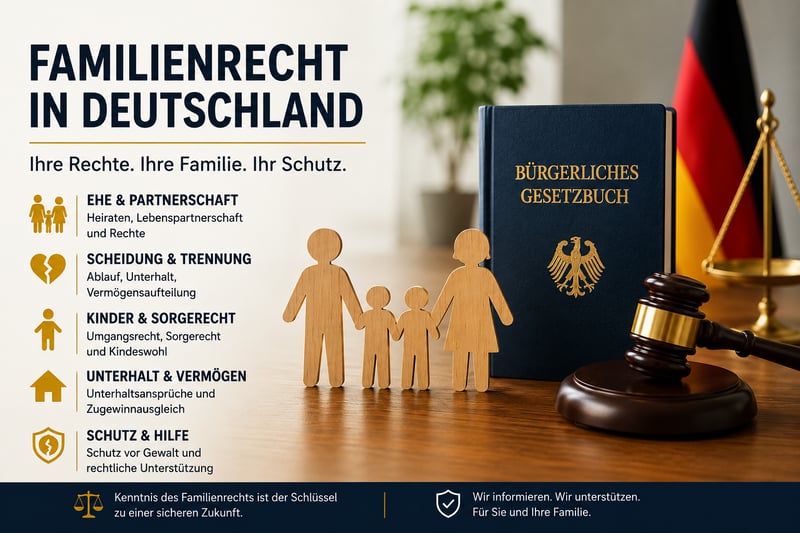
Marriage, Divorce, Child Custody, Family Rights, and Legal Protection ⸻ Introduction Family is one of the most important parts of every person’s life, and for this reason, family laws in Germany are highly significant. Many migrants living in Germany will sooner or later encounter issues such as: marriage, divorce, child custody, alimony and financial support, family-based residence permits, domestic violence, or the rights of parents and children. However, many people at the beginning of their journey are not fully familiar with German family law, and this lack of knowledge can sometimes lead to legal, family-related, or immigration problems. In Germany, family law is not only about marriage and divorce; rather, it is a collection of laws designed to protect the rights of family members, define parental responsibilities, and help preserve the safety and stability of the family. This article is a general introduction to the most important principles of family law in Germany. In future articles, each topic will be discussed separately and in greater detail. ⸻ What Is Family Law in Germany? A large part of German family law is contained in the Bürgerliches Gesetzbuch (BGB), also known as the German Civil Code. These laws regulate matters such as: marriage, divorce, child custody, alimony, inheritance, and parental responsibilities. ⸻ The Role of the Family Court In Germany, many family disputes are handled by the Familiengericht (Family Court). This court makes decisions regarding issues such as: divorce, child custody, visitation rights, alimony, and certain other family-related disputes. ⸻ Marriage in Germany Marriage in Germany is not only considered an emotional relationship, but also a legal relationship. For a marriage to become officially recognized, it generally must be registered at the Standesamt (civil registry office), official identification documents must be provided, and all legal requirements must be fulfilled. ⸻ Is a Religious Marriage Alone Sufficient? No. Only a marriage that has been officially and legally registered is considered valid by the German state. Therefore: a religious marriage ceremony, or a traditional ceremony, without official registration usually does not create full legal rights. ⸻ Divorce in Germany If a marital relationship can no longer continue, legal divorce is possible. However, in Germany, divorce is not considered a simple separation. Important issues such as child custody, division of assets, alimony, the child’s place of residence, and financial support may also arise. ⸻ The Year of Separation (Trennungsjahr) In many divorce cases, spouses are first required to live separately for one year. This period is called the Trennungsjahr (year of separation). The purpose of this law is to provide enough time for reflection and the possibility of reconciliation. ⸻ Child Custody in Germany One of the most sensitive areas of family law is Sorgerecht, meaning custody and parental responsibility. In Germany, the court generally considers the child’s best interests to be the most important factor when making decisions. ⸻ Do Both Parents Have Rights After Divorce? In many cases, yes. Even after divorce, both parents may continue to have a role in making important decisions regarding the child. ⸻ Alimony and Financial Support In certain situations, one parent or one spouse may be required to pay Unterhalt (financial support or alimony). The amount of support depends on factors such as: income, financial circumstances, the number of children, and living conditions. ⸻ Domestic Violence in Germany Germany takes physical violence, threats, psychological abuse, and domestic violence very seriously. In some situations, the police can remove the violent individual from the home, or the court can issue protective orders. According to Section 1 of the Protection Against Violence Act: § 1 GewSchG – Judicial Measures for Protection Against Violence and Stalking Text of the Law „Hat eine Person vorsätzlich den Körper, die Gesundheit oder die Freiheit einer anderen Person widerrechtlich verletzt, kann das Gericht die zur Abwendung weiterer Verletzungen erforderlichen Maßnahmen treffen. Das Gericht kann insbesondere anordnen, dass der Täter es unterlässt, die Wohnung der verletzten Person zu betreten, sich in einem bestimmten Umkreis der Wohnung aufzuhalten, zu bestimmende andere Orte aufzusuchen, an denen sich die verletzte Person regelmäßig aufhält, Verbindung zur verletzten Person aufzunehmen, auch unter Verwendung von Fernkommunikationsmitteln, Zusammentreffen mit der verletzten Person herbeizuführen.“ ⸻ Translation “If a person intentionally and unlawfully injures another person’s body, health, or freedom, the court may take the measures necessary to prevent further harm. In particular, the court may order the offender to refrain from: entering the injured person’s home, remaining within a specified distance of the residence, visiting places regularly frequented by the injured person, contacting the injured person, including by telephone, messages, or internet communication, or arranging meetings or encounters with the injured person.” ⸻ Simple Explanation According to this law, if a person threatens someone, commits domestic violence, continuously harasses another person, or causes fear and insecurity, the court can quickly issue: a restraining order, a no-contact order, or even an order removing the violent person from the shared home. ⸻ Simple Example If someone: constantly sends threatening messages, appears in front of another person’s home or workplace, or continues harassment after separation, the victim can request legal protection from the court under the GewSchG. ⸻ Children’s Rights in Germany In Germany, children’s rights are taken very seriously. The state aims to protect: the child’s safety, health, education, and overall well-being. In certain situations, the Jugendamt (Youth Welfare Office) may also become involved. ⸻ Family-Based Residence Permits For many migrants, family matters are directly connected to residence status. For example, marriage, divorce, custody disputes, or domestic violence may affect: residence permit extensions, permanent residence, or citizenship applications. ⸻ Common Mistakes Made by Migrants Some people do not take family law seriously, sign documents without fully understanding them, or assume that the law does not interfere in family matters. In practice, however, there are many important legal differences and consequences. ⸻ Important Warning In family-related matters, emotional decisions, violence, or ignoring the law can lead to serious legal, financial, and even immigration-related consequences. ⸻ Final Conclusion To have a safe and lawful family life in Germany: ✔ Take family laws seriously ✔ Be aware of your legal rights ✔ Do not rush important decisions ✔ In disputes, act calmly and legally ✔ In complex situations, seek professional advice In Germany, family law is not only about resolving disputes; its purpose is also to protect: family security, children’s rights, and social stability. ✔ Legal awareness ✔ Mutual respect ✔ Family responsibility These three principles are the foundation of a safe and healthy family life in Germany.
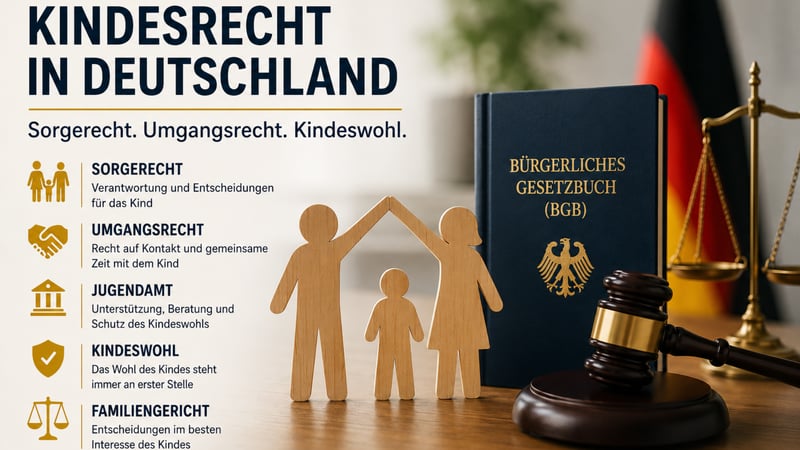
Child Visitation Rights and the Role of the Jugendamt ⸻ Introduction One of the most sensitive and important topics in German family law is child custody and parental rights. Many migrants living in Germany encounter terms such as Sorgerecht, Umgangsrecht, Jugendamt, and Familiengericht after divorce, separation, family disputes, or problems related to their children. However, many people do not fully understand what custody means in Germany, who has the authority to make decisions about a child, what role parents play in raising their children, and when the court or the Jugendamt become involved. Within migrant communities, there is also a great deal of misinformation and fear regarding this issue. Some people believe that “if a family dispute occurs, the Jugendamt will immediately take the child away from the family.” In reality, the legal situation is much more complex and very different from these assumptions. This article is a simple and practical guide to child custody, parental rights, and the role of legal institutions in Germany. ⸻ What Is Child Custody in Germany? In Germany, Sorgerecht means the legal right and responsibility of parents toward their child. This issue is not limited to where the child lives; it also includes decisions about: education, health care, school, medical treatment, place of residence, and other important aspects of the child’s life. ⸻ Important Legal Provision § 1626 BGB – Parental Custody Text of the Law „Die Eltern haben die Pflicht und das Recht, für das minderjährige Kind zu sorgen (elterliche Sorge).“ Translation “The parents have both the duty and the right to care for their minor child (parental custody).” ⸻ What Is the Main Goal of the Law? In Germany, the most important principle in family law cases is the Kindeswohl, meaning the child’s welfare and best interests. This means that courts and authorities first examine what is best and safest for the child and which conditions support the child’s healthy development. ⸻ Does Custody End After Divorce? No. Even after divorce, both parents may continue to share custody rights. This is called Gemeinsames Sorgerecht (joint custody). ⸻ What Is the Difference Between Custody and Visitation Rights? Many people confuse these two concepts. Sorgerecht means the legal right to make decisions about the child’s life. Umgangsrecht means the right to have contact and visitation with the child. After separation, the child may primarily live with one parent, but the other parent usually still has the right to maintain contact and a relationship with the child. In Germany, after separation or divorce, joint custody often continues. This means both parents remain involved in important decisions regarding the child’s life. The family court usually makes decisions based on: the child’s best interests (Kindeswohl), living conditions, the parents’ ability to care for the child, and the child’s safety and emotional stability. For this reason, German law does not automatically grant custody only to the mother or only to the father. Each case is examined individually according to the real circumstances of the family. In some situations, however, the child may mainly live with one parent, or sole custody may be granted to one parent. Such decisions require legal review or a court ruling. ⸻ What Happens If Parents Disagree? If parents disagree about issues such as: where the child should live, school, travel, medical treatment, or other important matters, the Familiengericht (Family Court) may make the final decision. ⸻ What Is the Role of the Jugendamt? One of the most important family-related institutions in Germany is the Jugendamt (Youth Welfare Office). Its role is to: support children, assist families, and protect the child’s safety and well-being. ⸻ Is the Jugendamt an Enemy of Families? Many migrants are afraid of the Jugendamt. In reality, the primary goal of this institution is usually to support children and help families — not to separate children from their parents. ⸻ When Does the Jugendamt Become Involved? For example, the Jugendamt may become involved in cases of: domestic violence, child abuse, severe neglect, serious addiction problems, or significant danger to the child’s well-being. ⸻ Can the Jugendamt Remove a Child From the Family? In very serious situations, yes. However, this decision is usually not simple, immediate, or made without legal review. In many cases, authorities first try to help the family, provide counseling, and improve the situation before considering removal of the child. ⸻ Fathers’ Rights in Germany Some migrants believe that “custody in Germany is always given to the mother.” This is incorrect. In many cases, fathers also have extensive legal rights, and courts generally try to preserve the child’s relationship with both parents. ⸻ What Happens If One Parent Prevents Contact? If one parent prevents the child from seeing the other parent without a valid legal reason: the court may intervene, or custody arrangements may be changed. ⸻ Domestic Violence and Custody If there is violence, threats, or serious danger, visitation rights may be restricted, or the court may impose protective measures. In Germany, the child’s safety is considered a very high priority. ⸻ Traveling Abroad With a Child In some cases, both parents’ consent is required for: travel, relocation, migration, or changing the child’s residence abroad. If there is disagreement, the court may decide. ⸻ The Effect of Criminal Cases on Custody If one parent commits: violence, abuse, severe addiction-related offenses, or dangerous crimes, this may affect custody rights or visitation rights. ⸻ Common Mistakes Made by Migrants Some people use the child as a tool to pressure the other parent, take the child out of Germany without permission, or believe that the law only supports one side. However, in Germany, the child’s welfare and emotional and social stability are considered far more important than the parents’ conflicts. ⸻ Important Warning In family cases, emotional decisions, threats, or severe conflicts can affect: custody rights, residence permits, and even the child’s future. ⸻ Final Conclusion To protect your rights and your child’s rights in Germany: ✔ Stay calm and act legally ✔ Do not involve the child in parental conflicts ✔ Learn your legal rights ✔ Avoid rushed decisions ✔ Seek professional advice in complicated cases In Germany, family law aims to protect the child, preserve healthy relationships between parents and children, and ensure the child’s emotional and social security. ✔ Parental responsibility ✔ The child’s emotional well-being ✔ Respect for the law These three principles form the foundation of decision-making in many family law cases in Germany.
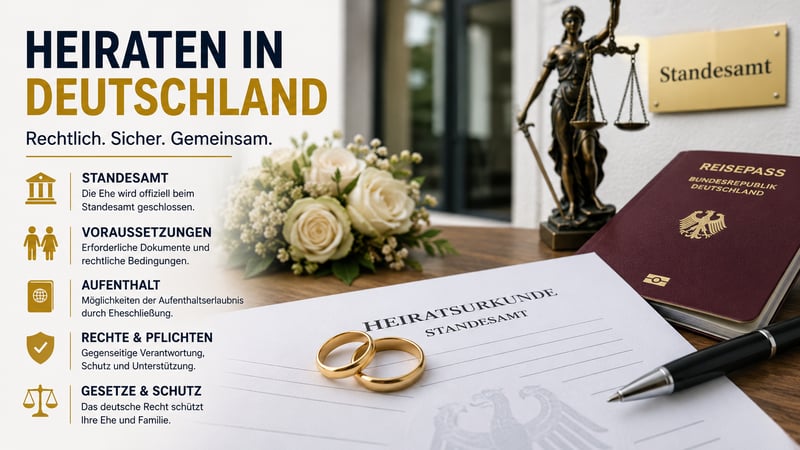
Legal Requirements, Marriage Registration, Family Residence Permits, and Important Rules for Migrants Introduction Marriage in Germany is not merely an emotional or religious relationship; it is also a formal legal relationship with significant legal, financial, family-related, and even immigration-related consequences. Many migrants living in Germany have questions about topics such as: Marriage registration Residence permits through marriage Family reunification visas Marriage to a German citizen The impact of divorce on residence status Many people also assume that: A religious marriage ceremony alone is sufficient, or Marriage automatically leads to permanent residence or citizenship. However, German laws in this area are very precise and strictly enforced. This article is a simple and practical guide to the most important marriage laws in Germany for migrants. ⸻ What Is a Legal Marriage in Germany? In Germany, an official marriage must be registered at the Standesamt (Civil Registry Office). Only after official registration is the marriage fully recognized as legally valid by the government, courts, and immigration authorities. ⸻ Important Legal Provision § 1353 German Civil Code (Bürgerliches Gesetzbuch – BGB) Text of the Law „Die Ehe wird von zwei Personen verschiedenen oder gleichen Geschlechts auf Lebenszeit geschlossen.“ Translation “Marriage is entered into for life by two persons of the same or different sex.” ⸻ Is a Religious Marriage Ceremony Sufficient? No. In Germany, a religious ceremony, traditional marriage contract, or marriage performed only in a mosque, church, or family ceremony generally does not have full legal effect unless it is officially registered at the Standesamt. ⸻ Documents Required for Marriage in Germany Depending on a person’s nationality and circumstances, the required documents may vary, but they usually include: A valid passport Birth certificate or identity documents Birth registration certificate Proof of residence Certificate of single status or divorce decree Certified translations of documents In some cases, confirmation from the relevant embassy ⸻ Can Migrants Get Married in Germany? Yes. Even individuals who are not German citizens or who hold foreign citizenship can, in many cases, legally marry in Germany. ⸻ Marriage to a German Citizen Marriage to a German citizen may provide the possibility of obtaining a family-based residence permit and living legally in Germany. However, marriage alone does not automatically result in permanent residence or German citizenship. Immigration authorities generally examine: Whether the relationship is genuine The couple’s financial circumstances Whether they share a common residence Compliance with residence regulations The immigration office usually verifies that a genuine marital relationship exists and that the marriage was not entered into solely for immigration purposes. If the authorities suspect that the marriage is not genuine, difficulties may arise during residence permit extensions or citizenship applications. However, if one spouse is required to live elsewhere temporarily due to studies, vocational training, or employment, these circumstances are generally recognized as legitimate and usually do not cause problems with residence permit renewals. ⸻ Residence Permits Through Marriage Many migrants may apply for Familiennachzug (family reunification) after marriage. Language Requirement for Family Reunification The requirements for family reunification depend on the immigration status of the migrant living in Germany. For example: If a person has applied for asylum and received a one-year subsidiary protection status, the chances of family reunification being approved may be relatively low. However, if asylum has been granted under Article 16a of the German Basic Law, the individual may apply for family reunification for their spouse and children under the age of 18 within three months after receiving the positive asylum decision. In such cases, the likelihood of approval is generally much higher. (A separate article provides a comprehensive explanation of family reunification rules for refugees.) For students and individuals holding employment-based residence permits (including the EU Blue Card), the chances of family reunification approval are generally significantly higher. Nevertheless, the applicant’s income level often plays an important role in the final decision. In many spouse reunification cases, proof of German language proficiency at the A1 level is required. Different rules may apply to children. Certain legal exceptions also exist. ⸻ Is Permanent Residence Granted After Marriage? Usually not. In most cases, a temporary family residence permit is issued first. The duration of this permit varies depending on the circumstances of the case and the decision of the immigration authorities. After several years of living together and fulfilling the legal requirements, permanent residence and, later, citizenship may become possible. ⸻ Sham Marriages (Scheinehe) One of the most sensitive issues for immigration authorities is the Scheinehe (sham marriage). What Is a Sham Marriage? A sham marriage is a marriage entered into solely for the purpose of obtaining a residence permit or circumventing immigration laws, without a genuine marital relationship. Do Immigration Authorities Investigate? Yes. In some cases, immigration authorities may: Conduct interviews Inspect the couple’s living arrangements Request additional documentation Consequences of a Sham Marriage If it is proven that the marriage is not genuine or was intended to deceive immigration authorities, the consequences may include: Refusal of a residence permit Revocation of an existing residence permit Criminal proceedings Deportation from Germany ⸻ Important Legal Provision Regarding Family Residence Permits § 27 Residence Act (Aufenthaltsgesetz – AufenthG) Text of the Law „Die Aufenthaltserlaubnis zur Herstellung und Wahrung der familiären Lebensgemeinschaft im Bundesgebiet wird zum Schutz von Ehe und Familie erteilt.“ Translation “A residence permit for establishing and maintaining family life within the Federal Republic of Germany is granted for the protection of marriage and family.” ⸻ Rights and Responsibilities of Spouses Marriage in Germany creates not only rights but also responsibilities. For example: Financial support obligations Family responsibilities Certain legal duties between spouses may arise. ⸻ Surnames After Marriage In Germany: Changing one’s surname after marriage is not mandatory. Spouses may keep their existing surnames or choose a common family name. ⸻ The Impact of Divorce on Residence Status Can divorce affect a person’s residence status? Yes. Divorce can affect residence rights, particularly when a residence permit is based on marriage and the marriage has existed only for a short period. However, each case is assessed individually. ⸻ Same-Sex Marriage in Germany Marriage between two men or two women is legal in Germany and enjoys the same legal rights and protections as any other marriage. ⸻ Common Mistakes Made by Migrants Some individuals: Sign documents without fully understanding them Assume marriage automatically leads to citizenship Confuse German immigration and family laws with the laws of their country of origin ⸻ Must Migrant Couples Re-register Their Marriage in Germany? If migrant spouses legally married in another country before immigrating to Germany, do they need to marry again in Germany? In many cases, if the marriage was legally registered abroad, the original marriage certificate together with a certified translation is sufficient to prove the marital relationship. However, in certain situations, formal recognition or registration of foreign documents in Germany may also be required. ⸻ Minimum Age for Marriage in Germany Legal Provision § 1303 BGB Text of the Law „Eine Ehe darf nicht vor Eintritt der Volljährigkeit eingegangen werden.“ Translation “Marriage may only be entered into after reaching legal adulthood (18 years of age).” This rule is particularly important for migrants because marriages involving individuals under the age of 18 may be legally recognized in some countries but are subject to significant restrictions in Germany. It should also be noted that, based on this provision, if one spouse was under the age of 16 at the time of marriage, such a marriage is generally not recognized in Germany and may be considered void—even if it was legally registered in another country. ⸻ Important Warning In Germany, the legal registration of marriage, honesty in immigration matters, and compliance with residence regulations are extremely important. Providing false information or forged documents can lead to serious immigration, financial, and criminal consequences. ⸻ Final Conclusion To build a secure and lawful family life in Germany: ✔ Register your marriage officially and legally ✔ Submit genuine and complete documentation ✔ Take immigration regulations seriously ✔ Do not sign anything without understanding it ✔ Seek professional advice in complex cases In Germany, marriage is not merely an emotional relationship; it is a legal relationship with important family and immigration consequences. The Three Foundations of a Secure and Lawful Family Life in Germany ✔ Responsibility ✔ Honesty ✔ Legal Awareness These three principles form the foundation of a secure and lawful family life in Germany.

You are expecting a baby, live together and have already chosen a name. It is easy to assume that being listed as the father also settles who may make important decisions for the child. Under German law, these are separate questions. Start with the Jugendamt or the registry office and explain that you want to discuss both paternity and custody. What the acknowledgment does A Vaterschaftsanerkennung establishes legal fatherhood once all requirements are met. It can be made before birth. The acknowledgment and necessary consents must be publicly authenticated; a private agreement, message or home signature is insufficient. The father normally makes his declaration personally, and the mother normally gives consent personally. The rules include exceptions, for example where the mother has died or a person lacks legal capacity. The child’s consent is also required under the current law. For a child under 14, representation rules apply. Where the mother has the relevant parental responsibility, her consent also counts as the required consent on the child’s behalf. A minor aged 14 or over who has limited legal capacity generally consents personally and needs the legal representative’s consent. Ask the authenticating office who must attend in your particular case. Joint custody is another decision An acknowledgment alone does not give unmarried parents joint custody. They can make publicly authenticated Sorgeerklärungen, for example at the Jugendamt or a notary, including before birth. Joint custody can also arise through the parents’ marriage or a family-court decision. Otherwise the mother generally has custody under §1626a BGB. Discuss what shared decisions will mean before signing. Custody is not a switch that can simply be turned off by a private message after a separation. Ask for an explanation of the declaration rather than treating it as routine birth paperwork. Check these complications early If another man is already the legal father, do not use a standard acknowledgment without advice. Current §1595a BGB allows acknowledgment by the biological father in certain cases with the existing legal father’s consent and the other necessary requirements. The old blanket statement that this always requires a completed divorce is unreliable. Since 29 July 2026, additional immigration-authority consent can be necessary in the status combinations defined by §85a AufenthG. This does not apply to every foreign parent. Statutory exemptions include biological fatherhood and certain established family situations. Ask which evidence the office requires before ordering translations or a genetic test. Acknowledgment itself does not guarantee a residence permit or citizenship. A practical example Mina and Farid are unmarried and expecting their first child. They arrange a Jugendamt appointment before the birth. They ask separately for the paternity acknowledgment and, if both want it, custody declarations. The office checks identities, civil status and necessary consents. They retain certified copies and clarify what the registry office needs for birth registration. Your checklist - Ask which office can authenticate both documents and whether appointments or fees apply. - Confirm the required passports or identity documents, birth certificates, pregnancy or birth evidence, and any marriage or divorce records. - Check translation, certification and interpreter requirements before paying for them. - Disclose any existing legal fatherhood or relevant residence-status complication. - Keep certified copies and check that names and dates match your documents. This guide concerns German-law procedures. Foreign nationality, an overseas birth, disputed parentage or existing foreign documents can require a family-law specialist familiar with international cases. Get individual advice before relying on an acknowledgment abroad. Checked: 18 October 2026. Official sources - BGB §1596: personal declarations and child consent https://www.gesetze-im-internet.de/bgb/1596.html - BGB §1597: public authentication https://www.gesetze-im-internet.de/bgb/1597.html - BGB §1595a: existing legal paternity https://www.gesetze-im-internet.de/bgb/1595a.html - BGB §1626a: unmarried parents and custody https://www.gesetze-im-internet.de/bgb/1626a.html - AufenthG §85a: immigration-authority consent and exemptions https://www.gesetze-im-internet.de/aufenthg2004/85a.html - German Foreign Office: paternity and change effective 29 July 2026 https://kairo.diplo.de/eg-de/service/1498588-1498588
A sudden hospital admission can leave ordinary life running without you: rent is due, letters arrive and doctors need decisions. Being your partner or adult child does not, by itself, give someone a general right to represent you. Planning now can spare your family difficult guesswork. Three documents, three jobs A Vorsorgevollmacht authorises a trusted person to act within the areas you specify, such as health, finances, housing or dealings with public bodies. A valid, sufficient power can avoid a court-appointed legal guardian when the authorised person can handle the necessary matters equally well. Grant it while you are an adult with legal capacity. A Betreuungsverfügung records your wishes if a court must appoint a legal guardian: whom you want, whom you reject and how you want matters handled. It does not itself give someone authority. The court must generally follow your choice of person unless that person is unsuitable. A Patientenverfügung records decisions about specified medical treatment for a future situation in which you cannot consent. It does not replace a power of attorney. A representative must respect applicable treatment instructions and your wishes, rather than decide according to their own preferences. What can a spouse do automatically? Under § 1358 BGB, a spouse may represent you in specified health matters if illness or unconsciousness prevents you from managing them legally. This includes treatment decisions and certain treatment, hospital and urgent care contracts. It does not provide general control over your bank account, investments or property. The authority lasts no longer than six months from the onset recorded by the doctor, and ends earlier if the conditions cease. The doctor must document the conditions and relevant date; the representing spouse must provide the required written assurances. Simply showing a marriage certificate is insufficient. The right is excluded, in particular, if you live separately, a rejection of this representation or a relevant power of attorney is known to the spouse or doctor, or a court-appointed guardian already covers the matter. It is not an automatic right for adult children or partners who are neither married nor in a registered civil partnership. Example: treatment is not banking Mina is unconscious after an accident. Her husband may, if all statutory conditions are met, make covered treatment decisions. That does not let him transfer money from her sole bank account to pay every household bill. A suitable financial power of attorney would address that separate problem. Your preparation checklist - Discuss the role with someone you trust completely and agree how they will keep records. - Specify the permitted areas and whether a substitute should act if your first choice cannot. - Prepare a written, dated and signed document. Certain serious medical decisions and liberty-restricting measures require explicit written authority; applicable court-approval requirements remain. - Clarify when the authority is effective and when the person should use it. An internal instruction is not necessarily a limitation outsiders can see. - Ask your bank which evidence or account-specific authorisation it needs. Keep the original accessible and tell the representative where it is. - Review the arrangements after separation, a move or a change in your trusted relationships. When to get help A notary should check property transactions, business interests, cross-border use and special formalities. A local Betreuungsbehörde or recognised Betreuungsverein can explain planning options. If you cannot entrust broad powers to anyone, discuss a Betreuungsverfügung rather than signing an unrestricted form. This guide is general information, not an assessment of your particular document. Checked: 18 October 2026. Official sources - BGB § 1358: Ehegattenvertretung https://www.gesetze-im-internet.de/bgb/1358.html - BGB § 1814: Erforderlichkeit einer Betreuung https://www.gesetze-im-internet.de/bgb/1814.html - BGB § 1816: Betreuungsverfügung und Auswahl https://www.gesetze-im-internet.de/bgb/1816.html - BGB § 1820: Vorsorgevollmacht https://www.gesetze-im-internet.de/bgb/1820.html - BGB § 1827: Patientenverfügung https://www.gesetze-im-internet.de/bgb/1827.html - Bundesjustizministerium: Vorsorgevollmacht https://www.bmj.de/DE/themen/vorsorgebetreuungsrecht/vorsorgevollmacht/vorsorgevollmachtnode.html
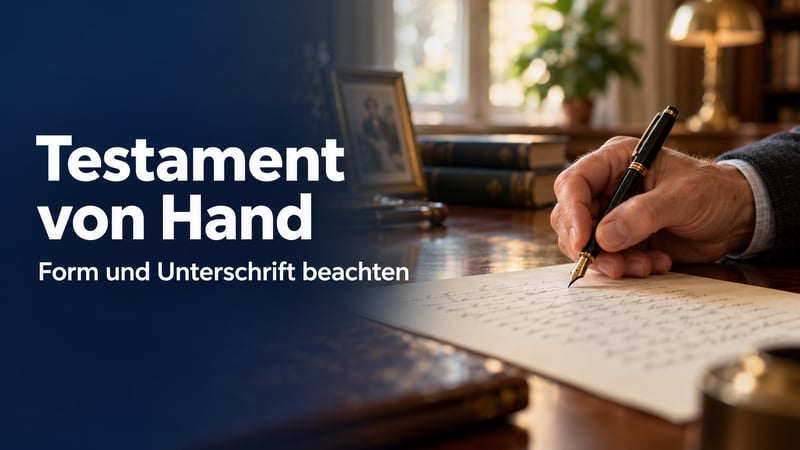
You want to leave clear instructions for your family, so you type a will, print it and sign it. That feels sensible, but it does not meet the German requirements for an ordinary handwritten will. A few basic distinctions can prevent your wishes from being lost in a formal mistake. Write it yourself, from beginning to end Under § 2247 BGB, you must personally write the entire declaration by hand and sign it. A typed document, email or printed template with your signature does not satisfy this form. Nor can someone else write the text for you. Witnesses and notarisation are not required for this ordinary handwritten form. Sign below the complete text, preferably with your first and last names. Include the place and full date. Date and place are strongly recommended, but their omission does not automatically invalidate the will: where the omission creates doubts about validity, the necessary information must be established in another way. Numbering pages helps keep a longer document together. This handwritten route is for adults who can read. You must also have testamentary capacity, meaning the ability to understand the significance of your declaration and act accordingly. If handwriting, reading or capacity raises concerns, obtain individual advice about a suitable notarial route. Notarisation cannot cure a lack of testamentary capacity. Identify heirs, not just objects Clearly identify the people you intend to make heirs and their shares. Full names and dates of birth help avoid confusion. Leaving someone a particular object as a Vermächtnis, or legacy, is legally different from appointing them an heir. Avoid a list of possessions that leaves unclear who receives the remaining estate. For example, Leila wants her brother to be her sole heir and her niece to receive a necklace. These are different roles. A typed, signed list would first fail the handwritten-form requirement; simply rewriting an ambiguous list by hand would still leave interpretation problems. Form and content both need attention. A will also does not automatically remove compulsory-share rights. Certain disinherited relatives, particularly children, spouses and in some cases parents, may have a monetary claim for half the value of their statutory inheritance share. That does not necessarily make them co-heirs. Keep the original findable You can request official custody of a handwritten will at the probate court, the Nachlassgericht. If you keep it yourself, choose a safe place that can be found after your death. A scan is useful for reference but does not replace proper handling of the original. Anyone holding a will outside official custody must deliver it to the probate court without delay after learning of the death. Do not wait for agreement among relatives. Your preparation checklist - List your wishes, assets and possible debts before drafting. - Identify heirs, shares and any separate legacies clearly. - Check existing wills or inheritance contracts before making changes; earlier arrangements may be binding. - Handwrite the final text, sign beneath it and add date and place. - Arrange safe storage and review after major family changes or a move. An international estate needs another check These German form rules do not settle which inheritance law applies. Under the EU Succession Regulation, habitual residence at death is generally decisive, subject to exceptions. A choice of law is generally limited to a country whose nationality you hold when choosing or at death. Existing international treaties may take priority; foreign recognition and inheritance tax are separate questions. For foreign citizenship, assets abroad, a planned international move, a joint will or family conflict, consult a notary or inheritance lawyer with the relevant cross-border expertise before signing. This article is general guidance, not a ready-made will for your situation. Checked: 18 October 2026. Official sources - BGB § 2247: Eigenhändiges Testament https://www.gesetze-im-internet.de/bgb/2247.html - BGB § 2229: Testierfähigkeit https://www.gesetze-im-internet.de/bgb/2229.html - BGB § 2248: Amtliche Verwahrung https://www.gesetze-im-internet.de/bgb/2248.html - BGB § 2259: Ablieferung nach dem Tod https://www.gesetze-im-internet.de/bgb/2259.html - BGB § 2303: Pflichtteil https://www.gesetze-im-internet.de/bgb/2303.html - EU-Verordnung 650/2012, Art. 21, 22, 75 https://eur-lex.europa.eu/legal-content/EN/TXT/HTML/?uri=CELEX:32012R0650

The rent is due, school expenses continue, and the other parent’s maintenance payment has not arrived. Unterhaltsvorschuss can help bridge that gap for an eligible child. You do not generally need to finish a maintenance lawsuit before applying. Start with your local Unterhaltsvorschussstelle, usually part of the Jugendamt. Who can qualify? The child must live in Germany with a parent who is single, widowed, divorced or permanently separated from their spouse or registered partner. That parent must clearly carry the predominant responsibility for raising the child. Living together with the child’s other parent excludes entitlement; an approximately equal shared-care arrangement needs particular scrutiny and generally does not meet the predominant-care requirement. The other parent must pay no maintenance, pay irregularly or pay less than the relevant advance amount. Support payments and certain other income are taken into account. There is no general maximum-income limit for the single parent. An unresolved paternity question does not automatically prevent an application, but cooperation in establishing paternity and locating the other parent is required. For children aged 12 through 17, one additional route must apply: the child does not receive SGB II benefits; the advance would remove the child’s need for those benefits; or the caring parent has at least €600 monthly qualifying income, excluding Kindergeld and before the statutory deductions. The office checks the relevant Jobcenter decision. This threshold is not the amount of the advance. For foreign nationals, eligibility also depends on the applicable free-movement or residence rules. Let the office check the child’s and caring parent’s actual documents rather than assuming that every residence permit qualifies or that foreign nationality excludes the benefit. How to apply without losing time Ask the responsible local office for its application form and document list. Submit a valid written application or use the approved electronic route where available. Keep proof of receipt. A telephone conversation alone is not a safe substitute for an application. Prepare identity and residence documents, the child’s birth certificate, proof of separation where relevant, details of the other parent, bank statements showing payments, and any maintenance decision or agreement. For an older child, include the requested Jobcenter and income documents. Keep a dated record of reasonable efforts to obtain maintenance. Payment can begin from the start of the application month if the conditions existed then. Retroactive payment is limited to the immediately preceding calendar month and requires the conditions to have existed plus reasonable efforts to obtain maintenance. Applying late can therefore leave earlier gaps uncovered. Example Sara’s eight-year-old lives mainly with her. Maintenance stops in September; she requests payment and saves the correspondence. She applies in October. September may also be considered if all conditions and the reasonable-efforts requirement were met. Payment for August is not available through this October application merely because support was also missing then. After the decision The amount depends on the child’s age, the statutory calculation and deductions, including relevant Kindergeld and maintenance received. Check the calculation in the decision rather than relying on an old internet table. The other parent’s maintenance obligation does not simply disappear. Report relevant changes immediately, including maintenance received, moving, marriage, resuming life with the other parent or changes to the child’s household. Living with a new unmarried partner does not by itself end entitlement; marriage while living together changes the position. Incorrect payments may have to be repaid. Your checklist - Submit the application and retain receipt evidence. - Record payments, missing payments and collection efforts. - Disclose care arrangements and residence status accurately. - Check the decision’s calculation and instructions for challenging it. - Report changes promptly, even while the application is pending. For shared-care disputes, a refusal or complicated residence status, seek individual advice from the Jugendamt, a social-law adviser or a suitable lawyer. This overview cannot determine your child’s entitlement. Checked: 18 October 2026. Official sources - UhVorschG §1: eligibility https://www.gesetze-im-internet.de/uhvorschg/1.html - UhVorschG §2: calculation https://www.gesetze-im-internet.de/uhvorschg/2.html - UhVorschG §4: payment periods https://www.gesetze-im-internet.de/uhvorschg/4.html - UhVorschG §6: reporting changes https://www.gesetze-im-internet.de/uhvorschg/6.html - UhVorschG §9: applications https://www.gesetze-im-internet.de/uhvorschg/9.html - Federal Family Portal: maintenance advance https://familienportal.de/familienportal/familienleistungen/unterhaltsvorschuss
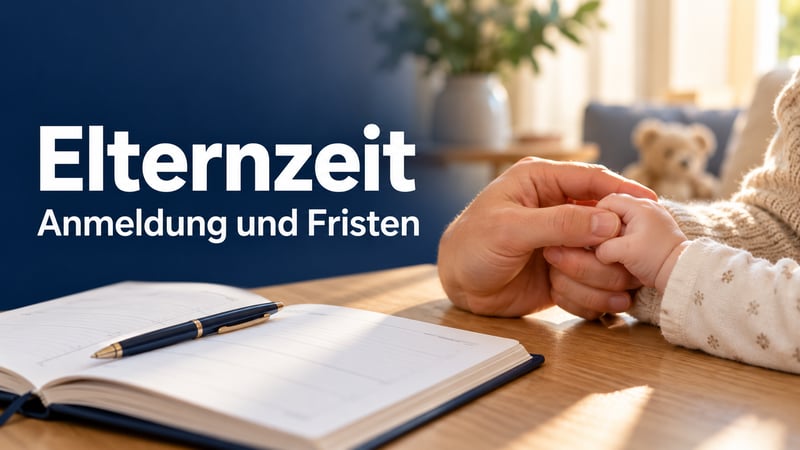
You want several months at home with your child. Before notifying your employer, check the birth date, proposed start and finances. Elternzeit notice and an Elterngeld application go to different places and do different jobs. Leave and money are separate Elternzeit is statutory, generally unpaid leave for eligible employees caring for a child in their household. Each parent can generally take up to three years per child, with up to 24 months between the third birthday and the day before the eighth birthday. Post-birth maternity protection counts towards the mother’s maximum leave entitlement. Elterngeld is a separate benefit applied for through the Elterngeldstelle. Taking leave does not automatically produce a payment, and the full leave period is not necessarily funded. Check benefit eligibility, the child’s life-months and health-insurance contributions before deciding how long to stop working. Self-employed people and civil servants need their own relevant rules checked. When must the employer receive notice? For the currently relevant age groups, notice must reach the employer: - At least seven weeks before leave taken before the third birthday. - At least 13 weeks before leave between the third and eighth birthdays. Urgent exceptional circumstances can justify a shorter appropriate period, but do not assume an exception without checking. If a non-birthing parent wants leave from birth, the calculated due date is used to plan the notice; the actual leave begins at birth. A mother taking leave after maternity protection must calculate her start accordingly. Is an email sufficient? For children born or taken into the household with a view to adoption from 1 May 2025, text form is sufficient, for example an email identifying you and clearly specifying the leave. For earlier birth or placement cohorts, the older written-form requirement continues: use a personally signed paper notice. An ordinary email or scan does not replace that requirement. The transition depends on the child’s date, not simply on sending the notice after May 2025. Keep proof that it reached the correct employer contact. Ask for the employer’s required confirmation of the leave and check the recorded dates. Plan the binding period When notifying leave before the third birthday, you must also state which periods within the following two years you will take. Maternity protection, and in the relevant case holiday immediately following it, count towards this period for the mother. Leaving a second period out can mean needing employer consent to add it later within the binding period. Early return and extensions also have rules and exceptions; do not change the dates unilaterally. For example, Lena’s child was born in June 2026. She wants leave starting in March 2027. Email can meet the form requirement, but she must still meet the seven-week deadline and state her plan for the binding period. A colleague whose child was born in April 2025 still needs the older written form. What protection applies? Special dismissal protection starts when leave is requested, but no earlier than eight weeks before leave before age three, or 14 weeks before leave from age three. It continues during the leave. In exceptional cases, the competent authority can permit dismissal. An ordinary fixed-term contract normally still ends on its agreed date; parental leave does not automatically extend it. Before sending - Verify the birth or adoption-placement date and required form. - Calculate receipt deadlines and the binding period. - State clear start and end dates; retain the notice and receipt evidence. - Plan Elterngeld and insurance separately. - Check part-time work or unusual leave splits separately. If dismissed, get employment-law advice immediately. The normal court-action deadline is three weeks from receipt of written dismissal; cases requiring authority approval have special timing rules. Do not assume protection makes a dismissal letter harmless. This guide is general information, not a review of your employment contract. Checked: 18 October 2026. Official sources - BEEG §15: entitlement https://www.gesetze-im-internet.de/beeg/15.html - BEEG §16: notice https://www.gesetze-im-internet.de/beeg/16.html - BEEG §18: dismissal protection https://www.gesetze-im-internet.de/beeg/18.html - BEEG §28: transitional rules https://www.gesetze-im-internet.de/beeg/28.html - Federal Family Portal: parental leave https://familienportal.de/familienportal/familienleistungen/elternzeit/faq - KSchG §4: court deadlines https://www.gesetze-im-internet.de/kschg/4.html