Загрузка
Marriage in Germany
Обновлено Jul 5, 2026
Язык статьиEnglish
Legal Requirements, Marriage Registration, Family Residence Permits, and Important Rules for Migrants
Introduction
Marriage in Germany is not merely an emotional or religious relationship; it is also a formal legal relationship with significant legal, financial, family-related, and even immigration-related consequences.
Many migrants living in Germany have questions about topics such as:
* Marriage registration
* Residence permits through marriage
* Family reunification visas
* Marriage to a German citizen
* The impact of divorce on residence status
Many people also assume that:
* A religious marriage ceremony alone is sufficient, or
* Marriage automatically leads to permanent residence or citizenship.
However, German laws in this area are very precise and strictly enforced.
This article is a simple and practical guide to the most important marriage laws in Germany for migrants.
⸻
What Is a Legal Marriage in Germany?
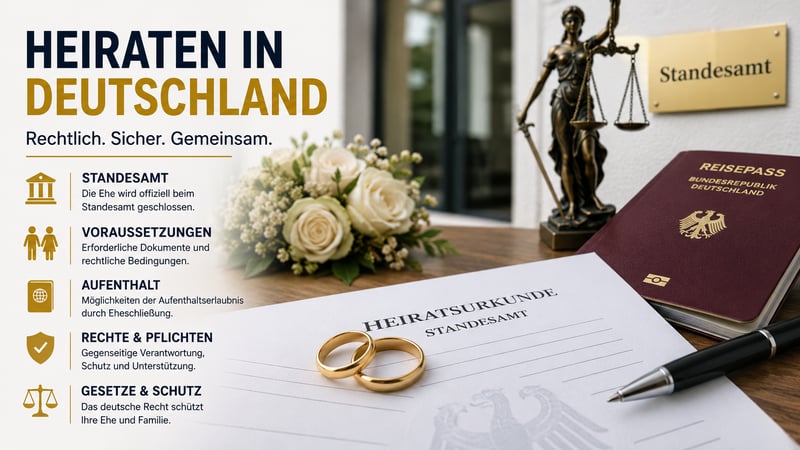
In Germany, an official marriage must be registered at the Standesamt (Civil Registry Office).
Only after official registration is the marriage fully recognized as legally valid by the government, courts, and immigration authorities.
⸻
Important Legal Provision
§ 1353 German Civil Code (Bürgerliches Gesetzbuch – BGB)
Text of the Law
„Die Ehe wird von zwei Personen verschiedenen oder gleichen Geschlechts auf Lebenszeit geschlossen.“
Translation
“Marriage is entered into for life by two persons of the same or different sex.”
⸻
Is a Religious Marriage Ceremony Sufficient?
No.
In Germany, a religious ceremony, traditional marriage contract, or marriage performed only in a mosque, church, or family ceremony generally does not have full legal effect unless it is officially registered at the Standesamt.
⸻
Documents Required for Marriage in Germany
Depending on a person’s nationality and circumstances, the required documents may vary, but they usually include:
* A valid passport
* Birth certificate or identity documents
* Birth registration certificate
* Proof of residence
* Certificate of single status or divorce decree
* Certified translations of documents
* In some cases, confirmation from the relevant embassy
⸻
Can Migrants Get Married in Germany?
Yes.
Even individuals who are not German citizens or who hold foreign citizenship can, in many cases, legally marry in Germany.
⸻
Marriage to a German Citizen
Marriage to a German citizen may provide the possibility of obtaining a family-based residence permit and living legally in Germany.
However, marriage alone does not automatically result in permanent residence or German citizenship.
Immigration authorities generally examine:
* Whether the relationship is genuine
* The couple’s financial circumstances
* Whether they share a common residence
* Compliance with residence regulations
The immigration office usually verifies that a genuine marital relationship exists and that the marriage was not entered into solely for immigration purposes.
If the authorities suspect that the marriage is not genuine, difficulties may arise during residence permit extensions or citizenship applications.
However, if one spouse is required to live elsewhere temporarily due to studies, vocational training, or employment, these circumstances are generally recognized as legitimate and usually do not cause problems with residence permit renewals.
⸻
Residence Permits Through Marriage
Many migrants may apply for Familiennachzug (family reunification) after marriage.
Language Requirement for Family Reunification
The requirements for family reunification depend on the immigration status of the migrant living in Germany.
For example:
If a person has applied for asylum and received a one-year subsidiary protection status, the chances of family reunification being approved may be relatively low.
However, if asylum has been granted under Article 16a of the German Basic Law, the individual may apply for family reunification for their spouse and children under the age of 18 within three months after receiving the positive asylum decision. In such cases, the likelihood of approval is generally much higher.
(A separate article provides a comprehensive explanation of family reunification rules for refugees.)
For students and individuals holding employment-based residence permits (including the EU Blue Card), the chances of family reunification approval are generally significantly higher. Nevertheless, the applicant’s income level often plays an important role in the final decision.
In many spouse reunification cases, proof of German language proficiency at the A1 level is required. Different rules may apply to children. Certain legal exceptions also exist.
⸻
Is Permanent Residence Granted After Marriage?
Usually not.
In most cases, a temporary family residence permit is issued first.
The duration of this permit varies depending on the circumstances of the case and the decision of the immigration authorities.
After several years of living together and fulfilling the legal requirements, permanent residence and, later, citizenship may become possible.
⸻
Sham Marriages (Scheinehe)
One of the most sensitive issues for immigration authorities is the Scheinehe (sham marriage).
What Is a Sham Marriage?
A sham marriage is a marriage entered into solely for the purpose of obtaining a residence permit or circumventing immigration laws, without a genuine marital relationship.
Do Immigration Authorities Investigate?
Yes.
In some cases, immigration authorities may:
* Conduct interviews
* Inspect the couple’s living arrangements
* Request additional documentation
Consequences of a Sham Marriage
If it is proven that the marriage is not genuine or was intended to deceive immigration authorities, the consequences may include:
* Refusal of a residence permit
* Revocation of an existing residence permit
* Criminal proceedings
* Deportation from Germany
⸻
Important Legal Provision Regarding Family Residence Permits
§ 27 Residence Act (Aufenthaltsgesetz – AufenthG)
Text of the Law
„Die Aufenthaltserlaubnis zur Herstellung und Wahrung der familiären Lebensgemeinschaft im Bundesgebiet wird zum Schutz von Ehe und Familie erteilt.“
Translation
“A residence permit for establishing and maintaining family life within the Federal Republic of Germany is granted for the protection of marriage and family.”
⸻
Rights and Responsibilities of Spouses
Marriage in Germany creates not only rights but also responsibilities.
For example:
* Financial support obligations
* Family responsibilities
* Certain legal duties between spouses
may arise.
⸻
Surnames After Marriage
In Germany:
* Changing one’s surname after marriage is not mandatory.
Spouses may keep their existing surnames or choose a common family name.
⸻
The Impact of Divorce on Residence Status
Can divorce affect a person’s residence status?
Yes.
Divorce can affect residence rights, particularly when a residence permit is based on marriage and the marriage has existed only for a short period.
However, each case is assessed individually.
⸻
Same-Sex Marriage in Germany
Marriage between two men or two women is legal in Germany and enjoys the same legal rights and protections as any other marriage.
⸻
Common Mistakes Made by Migrants
Some individuals:
* Sign documents without fully understanding them
* Assume marriage automatically leads to citizenship
* Confuse German immigration and family laws with the laws of their country of origin
⸻
Must Migrant Couples Re-register Their Marriage in Germany?
If migrant spouses legally married in another country before immigrating to Germany, do they need to marry again in Germany?
In many cases, if the marriage was legally registered abroad, the original marriage certificate together with a certified translation is sufficient to prove the marital relationship.
However, in certain situations, formal recognition or registration of foreign documents in Germany may also be required.
⸻
Minimum Age for Marriage in Germany
Legal Provision
§ 1303 BGB
Text of the Law
„Eine Ehe darf nicht vor Eintritt der Volljährigkeit eingegangen werden.“
Translation
“Marriage may only be entered into after reaching legal adulthood (18 years of age).”
This rule is particularly important for migrants because marriages involving individuals under the age of 18 may be legally recognized in some countries but are subject to significant restrictions in Germany.
It should also be noted that, based on this provision, if one spouse was under the age of 16 at the time of marriage, such a marriage is generally not recognized in Germany and may be considered void—even if it was legally registered in another country.
⸻
Important Warning
In Germany, the legal registration of marriage, honesty in immigration matters, and compliance with residence regulations are extremely important.
Providing false information or forged documents can lead to serious immigration, financial, and criminal consequences.
⸻
Final Conclusion
To build a secure and lawful family life in Germany:
✔ Register your marriage officially and legally
✔ Submit genuine and complete documentation
✔ Take immigration regulations seriously
✔ Do not sign anything without understanding it
✔ Seek professional advice in complex cases
In Germany, marriage is not merely an emotional relationship; it is a legal relationship with important family and immigration consequences.
The Three Foundations of a Secure and Lawful Family Life in Germany
✔ Responsibility
✔ Honesty
✔ Legal Awareness
These three principles form the foundation of a secure and lawful family life in Germany.