Загрузка
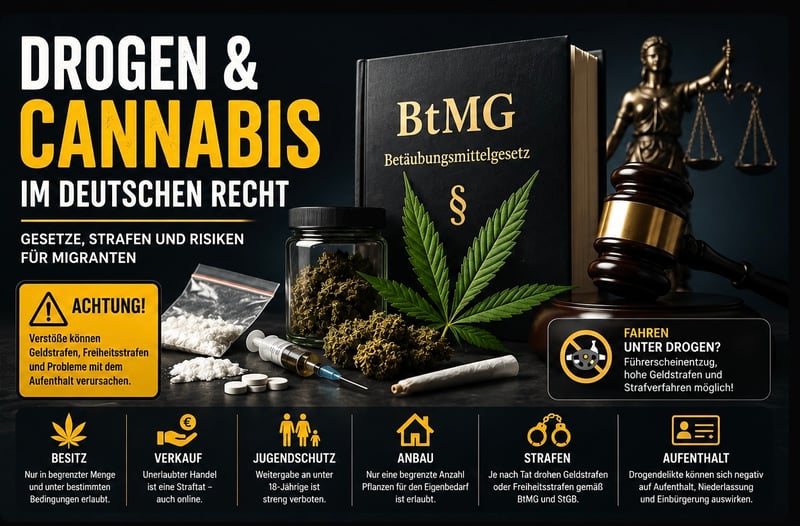
Drugs and Marijuana in German Law
Обновлено Jul 5, 2026
Язык статьиEnglish
Consumption, Possession, Purchase, Sale, and Driving Under the Influence of Drugs
Introduction
In recent years, the laws regarding Cannabis in Germany have changed. As a result, many people believe that “drugs have become legal in Germany.”
This assumption is completely incorrect.
In Germany, many narcotic substances remain illegal, and even regarding marijuana, there are still strict rules and limitations. Violating these laws may lead to criminal charges, fines, imprisonment, loss of a driver’s license, and even immigration or residency problems.
The main laws related to drugs in Germany include:
* The German Narcotics Act (BtMG)
* The Cannabis Act (CanG)
* Traffic and driving laws
* Immigration and residency regulations
⸻
Part One: Drug-Related Crimes
§ 29 BtMG – Drug-Related Offenses
Original German Text
„Mit Freiheitsstrafe bis zu fünf Jahren oder mit Geldstrafe wird bestraft, wer
Betäubungsmittel unerlaubt anbaut, herstellt, mit ihnen Handel treibt, sie, ohne Handel zu treiben, einführt, ausführt, abgibt, veräußert, sonst in den Verkehr bringt, erwirbt oder sich in sonstiger Weise verschafft,
Betäubungsmittel besitzt, ohne zugleich im Besitz einer schriftlichen Erlaubnis für den Erwerb zu sein.“
Translation
Any person who unlawfully cultivates, produces, trades, imports, exports, distributes, sells, places into circulation, acquires, or otherwise obtains narcotic substances shall be punished with imprisonment of up to five years or a monetary fine.
Likewise, any person who possesses narcotic substances without having written authorization to acquire them shall also be subject to the same punishment.
Simple Explanation
This section is one of the most important drug laws in Germany.
Under this law, the following actions may be considered criminal offenses:
* Buying drugs
* Selling drugs
* Transporting drugs
* Possessing drugs
* Importing drugs
* Even possessing a small quantity of drugs
Examples
Example 1
A person has a small amount of cocaine in their pocket.
Even if it is only for personal use, the police may open a criminal case against them.
Example 2
A person keeps drugs (for example, opium) for a friend.
Even if they are not personally using the drugs, they may still face criminal prosecution.
Example 3
A person imports drugs into Germany from another country.
Importing drugs usually carries much heavier penalties and may result in serious criminal consequences.
⸻
Part Two: Marijuana in Germany
The New Cannabis Act (CanG)
Since 2024, parts of Germany’s marijuana laws have changed.
However, these changes do not mean that marijuana is “fully legal.”
§ 3 CanG – Possession of Cannabis
Original Text
„Personen, die das 18. Lebensjahr vollendet haben, ist der Besitz von bis zu 25 Gramm Cannabis zum Eigenkonsum erlaubt.“
Translation
Persons who are at least 18 years old are allowed to possess up to 25 grams of cannabis for personal consumption.
Simple Explanation
Under certain conditions, adults may legally possess a limited amount of marijuana.
However, possessing more than the legal limit may still be considered a criminal offense.
⸻
§ 34 CanG – Criminal Provisions
Original Text
„Mit Freiheitsstrafe bis zu drei Jahren oder Geldstrafe wird bestraft, wer entgegen § 2 Absatz 1 Nummer 8 Cannabis verkauft, abgibt oder sonst in Verkehr bringt.“
Translation
Anyone who, contrary to legal regulations, sells cannabis, provides it to others, or otherwise distributes it, may be punished with imprisonment of up to three years or a monetary fine.
Important Note
Although marijuana consumption has become legal under certain conditions in Germany, illegal buying and selling remain criminal offenses, and the law does not permit unrestricted commercial sale.
The following actions may still be illegal:
* Selling marijuana without authorization
* Buying marijuana on the black market
* Consuming marijuana in prohibited areas
* Consuming marijuana near schools or kindergartens
* Giving marijuana to persons under 18
* Driving under the influence of marijuana
Examples
Example 1
A person consumes marijuana near a school.
This may be considered a violation or criminal offense.
Example 2
A person gives marijuana to a 17-year-old teenager.
This is treated very seriously and may lead to severe punishment.
Example 3
A person stores a large quantity of marijuana at home.
If the amount exceeds the legal limit, it may be considered a criminal offense.
⸻
Part Three: Driving Under the Influence of Drugs
§ 24a StVG – Driving Under the Influence of Intoxicating Substances
Original Text
„Ordnungswidrig handelt, wer unter der Wirkung eines berauschenden Mittels im Straßenverkehr ein Kraftfahrzeug führt.“
Translation
Any person who operates a motor vehicle in traffic while under the influence of an intoxicating substance commits an administrative offense.
Simple Explanation
In Germany, driving under the influence of the following substances is treated very seriously:
* Marijuana
* Cocaine
* Amphetamines
* Certain sleeping pills or medications that impair awareness
Possible Consequences
* Heavy fines
* Loss of driver’s license
* Driving bans
* Medical-Psychological Assessment (MPU)
* Criminal proceedings
Example
A person drives several hours after consuming marijuana.
Even if they appear sober, a police test may still come back positive, and the driving may be considered unlawful.
Part Four: Drunk Driving
§ 316 StGB – Intoxication in Traffic
Original Text
„Wer im Verkehr ein Fahrzeug führt, obwohl er infolge des Genusses alkoholischer Getränke oder anderer berauschender Mittel nicht in der Lage ist, das Fahrzeug sicher zu führen, wird bestraft.“
Translation
Anyone who drives a vehicle while being unable to operate it safely due to the consumption of alcohol or other intoxicating substances shall be punished.
Simple Explanation
If a person is unable to drive safely because of alcohol or intoxicating substances but still chooses to drive, they may be considered criminally liable under German law.
Many people believe that after completing the probationary driving period (Probezeit), which usually lasts 24 months, they are allowed to drive after drinking alcohol.
However, German law imposes special restrictions on beginner drivers.
⸻
§ 24c StVG – Alcohol Ban for Beginner Drivers
Original Text
„Ordnungswidrig handelt, wer als Führer eines Kraftfahrzeuges alkoholische Getränke zu sich nimmt oder die Fahrt antritt, obwohl er unter der Wirkung eines solchen Getränks steht, wenn er
die Fahrerlaubnis auf Probe hat oder
das 21. Lebensjahr noch nicht vollendet hat.“
Translation
A person commits an administrative offense if, as the driver of a motor vehicle, they consume alcoholic beverages or begin driving while under the influence of alcohol, if they:
* hold a probationary driver’s license, or
* are under 21 years of age.
Important Note
For drivers who are older than 21 and no longer in the probationary period, driving is generally permitted only if their blood alcohol concentration does not exceed 0.5 per mille.
If the blood alcohol level exceeds this limit, the police may take legal action.
It is also important to remember that alcohol affects people differently depending on their physical condition and other factors. Therefore, the safest decision is always to avoid alcohol before driving.
⸻
Part Five: Immigrants and Drug-Related Crimes
§ 53 AufenthG – Deportation
Original Text
„Ein Ausländer wird ausgewiesen, wenn sein Aufenthalt die öffentliche Sicherheit und Ordnung gefährdet.“
Translation
A foreign national may be deported if their presence endangers public safety and public order.
Examples
Example 1
A person has repeatedly been convicted of purchasing or possessing drugs.
This may negatively affect the extension of their residence permit.
Example 2
A person has participated in drug dealing.
This may create a risk of deportation from Germany.
Important Warning for Immigrants
In Germany, drug-related offenses are treated very seriously.
Even possessing a small amount of drugs may:
* Be entered into a criminal record
* Cause immigration or residency problems
* Lead to deportation in serious cases
Important Note About Marijuana
Many people believe:
“Since marijuana has been partially legalized, there is no longer any problem.”
This assumption is incorrect.
In Germany, the following factors still matter legally:
* The amount consumed
* The place of consumption
* The person’s age
* Driving
* The way marijuana was obtained
Final Conclusion
To live safely and legally in Germany:
* Take drug laws seriously.
* Do not assume marijuana is completely legal.
* Never drive under the influence of drugs or alcohol.
* Stay away from illegal drug trading.
* Respect laws concerning minors and public places.
In Germany, drug-related crimes can affect not only criminal records, but also employment opportunities, residency status, and social life.
Three Important Principles for a Safe and Lawful Life in Germany:
* Awareness
* Responsibility
* Respect for the law
Больше в этой категории(5)
- Crimes Against Personal Freedom in German Criminal Law
- Financial and Property Crimes in German Criminal Law
- Insults & Threats in German Law (§ 185, § 241 StGB): Penalties Explained
- Insults, Threats, and Internet Crimes Under German Law
- Sexual Violence and Offenses in the German Criminal Code (Part 2)