در حال بارگذاری
Permanent Residence in Germany
بهروزرسانی در Jul 5, 2026
زبان مقالهEnglish
Requirements, Benefits, Laws, and the Difference Between Permanent and Temporary Residence
⸻
Introduction
For many immigrants living and working in Germany, obtaining permanent residence is one of the most important stages of their immigration journey. Many people spend years living with temporary residence permits and constantly worry about:
* renewing their residence permit,
* work contracts,
* changes in immigration laws,
* or decisions made by the immigration office.
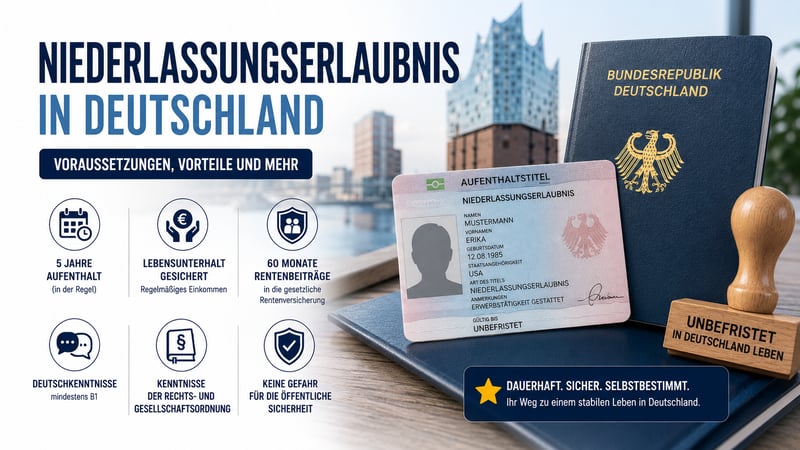
Permanent residence in Germany, known as the Niederlassungserlaubnis, allows individuals to live and work in Germany without time limitations and provides significantly greater security of residence.
However, contrary to what some people believe, permanent residence is not granted automatically. German immigration authorities examine a person’s financial situation, length of residence, pension insurance contributions, German language skills, criminal record, and level of integration into society.
⸻
What Is Permanent Residence in Germany?
Permanent residence is a type of unlimited residence permit in Germany.
Unlike temporary residence permits, it:
* has no expiration date,
* is not tied to a specific employer,
* and offers greater residential security.
A person with permanent residence can:
* work freely,
* change jobs,
* start a business,
* and usually has far fewer concerns about renewing their residence permit.
⸻
Difference Between Permanent Residence and German Citizenship
Many people confuse these two concepts.
Permanent residence means:
* the right to live permanently in Germany,
but the person still:
* does not have a German passport,
* cannot vote,
* and is not considered a German citizen.
German citizenship (Einbürgerung) is a higher legal status in which a person officially becomes a citizen of Germany.
⸻
Legal Basis for Permanent Residence
§ 9 Aufenthaltsgesetz (AufenthG)
Text of the Law
„Einem Ausländer ist die Niederlassungserlaubnis zu erteilen, wenn
er seit fünf Jahren die Aufenthaltserlaubnis besitzt,
sein Lebensunterhalt gesichert ist,
er mindestens 60 Monate Pflichtbeiträge oder freiwillige Beiträge zur gesetzlichen Rentenversicherung geleistet hat,
Gründe der öffentlichen Sicherheit oder Ordnung nicht entgegenstehen,
ihm die Beschäftigung erlaubt ist,
er über ausreichende Kenntnisse der deutschen Sprache verfügt
und
er über Grundkenntnisse der Rechts- und Gesellschaftsordnung und der Lebensverhältnisse im Bundesgebiet verfügt.“
⸻
Translation
“A foreign national shall be granted permanent residence if:
* they have held a residence permit for at least five years;
* they can financially support themselves;
* they have paid at least 60 months of mandatory or voluntary pension insurance contributions;
* there are no public security or public order concerns;
* they are permitted to work;
* they possess sufficient German language skills;
* and they have basic knowledge of Germany’s legal and social system and living conditions.”
⸻
Five-Year Residence Requirement
In most cases, a person must have legally lived in Germany for at least 5 years. The type of residence permit matters, and some residence periods may not be fully counted.
For example, if a person was legally subject to deportation to another country under the Dublin Regulation for 6 months, but the deportation was later suspended, the five-year calculation usually begins after the Dublin procedure ended.
⸻
Pension Insurance Requirement
One of the most important requirements for permanent residence is:
payment of at least 60 months of pension insurance contributions (Rentenversicherung).
These payments are usually made through:
* legal employment,
* or certain voluntary contributions.
⸻
German Language Requirement
In most cases, applicants must provide proof of German language skills at the B1 level when applying for permanent residence.
The immigration office wants to ensure that the person:
* can live independently,
* and is able to integrate into German society.
⸻
Income and Financial Situation
The applicant must prove that:
* they have stable income,
* they are not fully dependent on government assistance,
* and they can support themselves and their family financially.
⸻
Does Receiving Jobcenter Benefits Cause Problems?
In many cases, applications from people receiving government financial assistance are either rejected or require longer review periods.
However, holders of the EU Blue Card can usually obtain permanent residence more quickly.
According to Section 18c of the Residence Act:
⸻
§ 18c Aufenthaltsgesetz (AufenthG) – Permanent Residence for Skilled Workers
Text of the Law
„(1) Einem Fachkraft mit einer Aufenthaltserlaubnis nach den §§ 18a, 18b oder 18d ist ohne Zustimmung der Bundesagentur für Arbeit eine Niederlassungserlaubnis zu erteilen, wenn
sie seit drei Jahren im Besitz einer Aufenthaltserlaubnis ist,
sie mindestens 36 Monate Pflichtbeiträge oder freiwillige Beiträge zur gesetzlichen Rentenversicherung geleistet hat,
die Voraussetzungen des § 9 Absatz 2 Satz 1 Nummer 2 und 4 bis 6, 8 und 9 vorliegen und
sie über ausreichende Kenntnisse der deutschen Sprache verfügt.
(2) Abweichend von Absatz 1 ist Inhabern einer Blauen Karte EU eine Niederlassungserlaubnis zu erteilen, wenn sie mindestens 27 Monate eine Beschäftigung nach § 18g ausgeübt haben und für diesen Zeitraum Pflichtbeiträge oder freiwillige Beiträge zur gesetzlichen Rentenversicherung geleistet haben und über einfache Kenntnisse der deutschen Sprache verfügen. Abweichend hiervon beträgt die Frist 21 Monate, wenn die Fachkraft über ausreichende Kenntnisse der deutschen Sprache verfügt.“
⸻
Translation
§ 18c Residence Act – Permanent Residence for Skilled Workers
“(1) A skilled worker holding a residence permit under Sections 18a, 18b, or 18d shall be granted permanent residence without approval from the Federal Employment Agency if:
* they have held a residence permit for at least three years;
* they have paid at least 36 months of pension insurance contributions;
* they fulfill the requirements listed in Section 9 paragraph 2 numbers 2 and 4–6, 8, and 9;
* and they possess sufficient German language skills.
(2) EU Blue Card holders may receive permanent residence if:
* they have worked in a qualifying position for at least 27 months,
* have paid pension insurance contributions during that time,
* and possess basic German language skills.
This period is reduced to 21 months if the person has sufficient German language skills.”
⸻
The Impact of Unemployment on Permanent Residence
Many immigrants worry that losing their job shortly before applying for permanent residence — or during the application process — may negatively affect their case.
Short-term unemployment usually does not create major problems if the person has a good employment and financial history.
However:
* long-term unemployment,
* heavy dependence on state benefits,
* or tax-related problems
can negatively affect the application.
⸻
Is a Criminal Record Important?
Yes, very important.
Crimes such as:
* violence,
* drug offenses,
* theft,
* fraud,
* cybercrime,
* or using fake documents
may result in:
* rejection of permanent residence,
* delays in the application process,
* or even problems extending residence permits.
⸻
Benefits of Permanent Residence
Obtaining permanent residence offers many advantages:
✔ Greater residential security
✔ More freedom in employment
✔ Easier job changes
✔ Ability to start a business
✔ Better chances of obtaining loans
✔ Less stress about renewing residence permits
✔ Easier pathway to German citizenship
⸻
Dangerous Mistakes
Some mistakes can seriously damage an application:
* failing to pay taxes,
* interruption of insurance coverage,
* submitting fake documents,
* criminal offenses,
* hiding information,
* or violating immigration laws.
⸻
Final Conclusion
Permanent residence in Germany is one of the most important stages of immigration life and can provide greater stability, security, and freedom.
To improve the chances of obtaining permanent residence:
✔ Take German language learning seriously
✔ Pay taxes and insurance regularly
✔ Avoid criminal records
✔ Submit genuine documents
✔ Continuously monitor your residence status
In Germany, permanent residence is not just a residence card; it is a sign of stability and legal trust from the German state.
⸻
✔ Stability
✔ Security
✔ Long-term future
These are the main reasons why many immigrants work hard to obtain permanent residence in Germany.