Завантаження
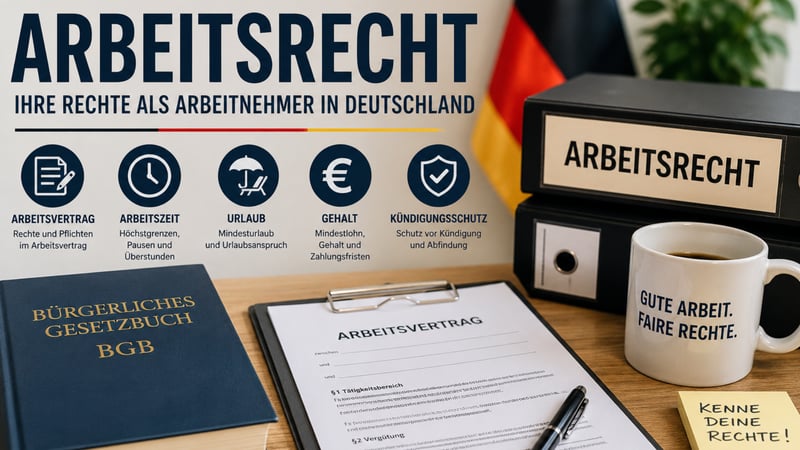
Introduction to Labor Law in Germany
Оновлено Jul 5, 2026
Мова статтіEnglish
Employment Contracts, Employee Rights, Working Hours, and Important Workplace Regulations
⸻
Introduction
Many immigrants entering the German job market are not fully familiar with the country’s labor laws at the beginning of their journey. This sometimes leads to misunderstandings, workplace problems, or even exploitation.
In Germany, labor law is not only about monthly salary. Issues such as:
* employment contracts,
* working hours,
* vacation,
* sick leave,
* dismissal from work,
* overtime,
* job security,
* and the relationship between employer and employee
are all regulated by specific laws.
The purpose of German labor law is to create a balance between:
* the rights of employers,
* the job security of employees,
* and order within the workplace.
This article is a general introduction to the most important principles of labor law in Germany. In future articles, each topic will be explained separately and in greater detail.
⸻
Employment Contracts (Arbeitsvertrag) in Germany
In most jobs, the working relationship between employer and employee is regulated through an:
employment contract.
This contract usually includes:
* type of work,
* salary,
* working hours,
* number of vacation days,
* duration of the contract,
* probation period (Probezeit),
* and conditions for terminating the contract.
⸻
Are verbal contracts legally valid?
In many cases:
Yes.
Even if there is no written contract, an employment relationship may still be legally valid.
However, having a written contract is extremely important because in the event of disputes, proving:
* salary,
* working hours,
* or employee rights
can become much more difficult without written documentation.
⸻
Probation Period (Probezeit)
In many employment contracts, the first few months are considered the:
probation period.
Typically, the probation period can last up to:
6 months,
although it may be shortened by agreement between both parties.
One important feature of the probation period is that both the employer and employee can usually terminate the contract more easily during this time.
⸻
Working Hours in Germany
German law sets clear limits on working hours.
⸻
Important Legal Provision
§ 3 Arbeitszeitgesetz (ArbZG)
German Legal Text
„Die werktägliche Arbeitszeit der Arbeitnehmer darf acht Stunden nicht überschreiten.“
⸻
Translation
“The daily working time of employees may not exceed eight hours.”
⸻
Simple Explanation
In many professions:
* the standard working day is 8 hours.
However, under certain conditions:
* legal overtime may be allowed,
provided that rest periods and average working time regulations are respected.
⸻
Breaks and Rest Periods (Pause)
In Germany, employees working long shifts are entitled to:
breaks (Pause).
Employers are legally required to follow regulations regarding:
* rest periods,
* and working time limits.
⸻
Minimum Wage (Mindestlohn) in Germany
Germany has a:
legal minimum wage.
Employers generally may not pay less than the legally established minimum wage, except in certain specific legal situations.
The minimum wage may change every year.
⸻
Vacation Leave (Urlaub) in Germany
Employees in Germany are entitled to:
paid vacation leave.
Under German law, many employees receive:
at least 20 working days of vacation per year,
while many companies provide even more vacation days.
⸻
Sick Leave and Illness
If an employee becomes ill:
* they must inform the employer,
* and in some cases provide a medical certificate.
In many situations, employees continue receiving their salary while on sick leave.
⸻
Dismissal from Work (Kündigung) in Germany
In Germany, dismissal from work is not always immediate or unrestricted.
Many employees are protected by labor laws, and employers must follow specific legal procedures.
⸻
Very Important Note
If someone receives a:
Kündigung (termination letter),
they usually need to act quickly.
In many cases, there are only:
3 weeks
to file a legal objection.
⸻
Can an employer assign work outside the contract?
This is one of the most common questions among immigrants.
In some situations, employers may assign:
* related,
* reasonable,
* and job-appropriate tasks
to employees.
For example:
if someone is employed as an electrician, they may also be asked to:
* organize tools,
* clean their work area,
* or keep the workspace tidy.
These duties are generally considered normal.
⸻
But where is the legal limit?
An employer may not:
* constantly force completely unrelated tasks,
* humiliate employees,
* or abuse their position.
For example:
forcing an electrician to clean the company’s public restroom every day after work could become legally problematic.
⸻
Overtime (Überstunden)
Many immigrants believe overtime is always mandatory.
However:
* overtime conditions must be legal,
* and in many cases overtime must be compensated:
* either financially,
* or with additional time off.
⸻
Discrimination in the Workplace
In Germany, discrimination based on:
* race,
* religion,
* gender,
* or ethnicity
is illegal.
Employees have the right to work in a safe and respectful environment.
If discriminatory behavior occurs, whether from:
* the employer,
* or other coworkers,
the affected employee has the right to:
* object,
* and in some situations even file a legal complaint.
⸻
Common Mistakes Made by Immigrants
Some immigrants:
* sign contracts without reading them,
* are unaware of their legal rights,
* or fail to document working hours and overtime.
This can sometimes lead to workplace problems or exploitation.
⸻
Important Warning
In Germany:
* employment contracts,
* health insurance,
* tax payments,
* and legal work registration
are extremely important.
Otherwise, illegal employment:
Schwarzarbeit
may be assumed and can create serious legal problems for both:
* the employee,
* and the employer.
For immigrants, in addition to financial penalties, it may also negatively affect:
* residence permits,
* and insurance status.
⸻
Understanding Your Contract
Since employment contracts in Germany are usually written in German, immigrants who are not sufficiently fluent in the language should ideally:
* translate the contract before signing,
* or seek help from a trusted translator or legal expert,
so they fully understand the agreement they are about to sign.
⸻
Final Conclusion
To build a safe and stable working life in Germany:
✔ Read your employment contract carefully
✔ Know your legal rights
✔ Keep records of working hours and overtime
✔ Take taxes and insurance seriously
✔ Act quickly if workplace problems arise
In Germany, understanding labor law is not only about avoiding problems — it also helps people work and live with greater security, confidence, and awareness.
⸻
✔ Awareness
✔ Responsibility
✔ Knowledge of legal rights
These three principles are the foundation of professional and workplace success in Germany.