Завантаження
Ending an Employment Contract in Germany
Оновлено Jul 5, 2026
Мова статтіEnglish
Employee Rights, Deadlines for Objection, and Important Legal Mistakes
⸻
Introduction
For many immigrants working in Germany, receiving a termination letter — known as a Kündigung — is one of the most stressful events in their working life.
Some people believe that in Germany an employer can terminate an employee at any time and without reason. In reality, however, German labor law protects employees in many situations, and employers are required to follow specific legal rules and procedures.
At the same time, many immigrants lose their opportunity to object because they are unaware of the law, sign incorrect documents, or face financial and residency problems without knowing their rights.
This article is a simple and practical guide about the conditions and rules for ending an employment relationship in Germany.
⸻
What is a Kündigung?
A Kündigung is an official written notice that ends an employment relationship.
This termination may come:
* from the employer,
* or from the employee.
However, both parties must follow the conditions stated in the employment contract, provided those conditions do not conflict with German law.
For example:
If the employment contract signed by both parties states that the employee must provide written notice 4 weeks before the intended end date of employment, the employee cannot simply choose a termination date only 2 weeks away — except in certain special situations explained later in this text.
⸻
Types of Termination in Germany
In Germany there are several main types of Kündigung:
1. Ordentliche Kündigung
Ordinary termination with the legally required notice period.
2. Fristlose Kündigung
Immediate termination without observing the legal or contractual notice period.
3. Aufhebungsvertrag
A mutual agreement between both parties to end the employment relationship.
⸻
Question: Can an employment contract be terminated verbally?
Usually no.
In Germany, a Kündigung must be written and official.
This means that a WhatsApp message, phone call, email, or verbal dismissal alone is generally not sufficient. The party requesting termination must provide a written letter including signature, date, and formal notice of termination.
⸻
Important Legal Provision
§ 623 BGB – Written Form of Termination
Text of the Law
„Die Beendigung von Arbeitsverhältnissen durch Kündigung oder Auflösungsvertrag bedarf zu ihrer Wirksamkeit der Schriftform.“
⸻
Translation
“The termination of employment relationships through dismissal or termination agreement requires written form in order to be legally valid.”
⸻
Probation Period (Probezeit) and Dismissal
In many employment contracts, the first few months are considered a Probezeit (probation period).
During this period, ending the employment relationship is usually easier, and the notice period is shorter.
However, even during probation, certain protective laws and anti-discrimination rules still apply.
⸻
The Most Common Mistake Among Immigrants
Some people believe:
“Because I am in Probezeit, I have no rights.”
This assumption is completely wrong.
The law still protects employees, and if you disagree with the termination by the employer, you still have the right to object.
⸻
Deadline to Challenge a Dismissal
Very important:
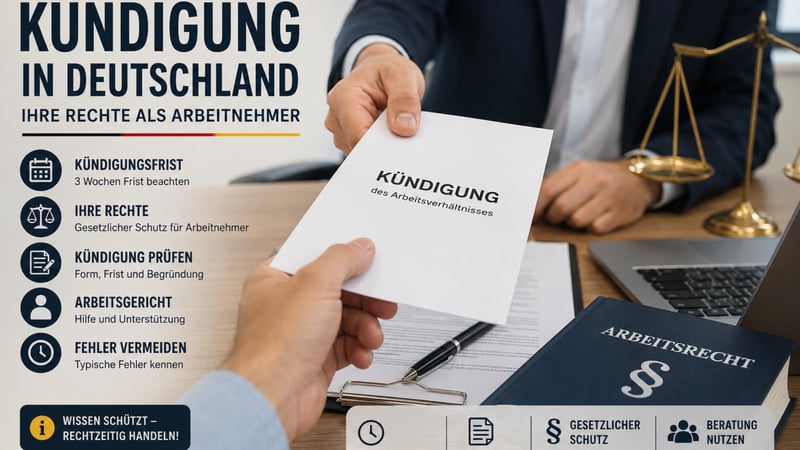
If a person receives a Kündigung, they usually have only 3 weeks to file an objection at the Arbeitsgericht (Labor Court).
If this deadline is missed, even an unlawful dismissal may later be considered legally valid.
⸻
Example
Imagine that:
your employer dismisses you without a valid reason, but you put the letter aside or react too late.
After the legal deadline expires, challenging the dismissal becomes much more difficult. You would then need a convincing reason explaining why you failed to act on time; otherwise, the chances of your case being reviewed become very low.
Examples of convincing reasons include:
* serious illness and hospitalization,
* death of close family members,
* or similar exceptional situations.
⸻
Does the Employer Have to Explain the Reason for Dismissal?
Yes.
Especially in larger companies where the Kündigungsschutzgesetz (KSchG) — the Protection Against Dismissal Act — applies.
⸻
What is a Fristlose Kündigung?
A Fristlose Kündigung means immediate termination, where the employer claims that continuing the employment relationship is no longer acceptable.
For example:
If the employer can prove theft, violence, threats, serious insults, fraud, or major violations of company rules by the employee, they may terminate employment very quickly.
In some situations, the employer may terminate the contract without respecting the ordinary notice period. However, this still must comply with the law and can still be challenged in court.
⸻
Can Illness Lead to Dismissal?
Many immigrants fear this issue and therefore try to continue working even while sick.
However, in Germany there is a common saying:
“Health comes first, then work.”
This means that if you genuinely feel unwell, you may use sick leave.
Short-term illness is generally not a sufficient reason for dismissal — unless the employer discovers that the illness was fake and the employee only pretended to be sick to avoid work.
For example:
An employee claims to be ill and unable to work, but it later becomes clear that the person was traveling and not actually sick.
Another situation may occur if a person becomes permanently unable to continue working because of illness and can no longer perform as before. In such cases, termination may become possible.
Otherwise, a few days of rest because of a cold or short-term illness is normally not a valid reason for dismissal.
⸻
Dismissal During Pregnancy
In Germany, pregnant women enjoy very strong legal protection.
Therefore, dismissal during pregnancy or shortly after childbirth is generally illegal.
No employer may dismiss an employee simply because of pregnancy.
⸻
What is an Aufhebungsvertrag?
Some employers suggest signing an Aufhebungsvertrag instead of issuing a Kündigung.
This means ending the employment relationship through mutual agreement.
⸻
Important Warning
Some immigrants sign such agreements without consultation.
However, this may negatively affect unemployment benefits, residence status, or social benefits.
Keep in mind:
If the termination comes from the employer, you may apply for unemployment benefits through the employment office.
Depending on your employment history and family situation, you may receive approximately 65% to 75% of your net salary for a period between 9 and 15 months.
However, if the termination request comes from you, or if the contract ends through mutual agreement, unemployment benefits may be delayed or restricted.
⸻
What Should You Do After Receiving a Termination Letter?
If you receive a Kündigung:
✔ Stay calm
✔ Record the date you received the letter
✔ Do not forget the 3-week deadline
✔ Do not sign anything without reading carefully
✔ If necessary, consult a lawyer or a Beratungsstelle (advisory center)
You should also contact the Agentur für Arbeit to officially register your unemployment status and apply for possible social support.
⸻
Can Dismissal Affect Residence Status?
For some immigrants: yes.
Especially if the residence permit is tied to employment, or if the person remains unemployed for a long period.
However, not every dismissal means losing your residence permit.
⸻
Discrimination and Unlawful Dismissal
If a dismissal happens because of nationality, religion, gender, age, or other discriminatory reasons, it may be considered unlawful.
⸻
The Role of the Labor Court (Arbeitsgericht)
The Arbeitsgericht is the specialized court for employment disputes in Germany.
Many cases involving dismissals, salaries, overtime, and workplace disputes are handled there.
⸻
Dangerous Mistakes Made by Immigrants
Some people ignore the Kündigung letter, react too late, or sign documents without fully understanding them.
This can create serious legal problems.
It is also important to know that signing confirmation of receipt of a termination letter does not necessarily mean accepting the dismissal itself.
⸻
Final Conclusion
In Germany, losing a job does not always mean losing all employee rights.
Many employees still have the right to object, receive legal protection, and pursue legal action.
To protect your rights:
✔ Keep your employment contract
✔ Take official letters seriously
✔ Respect legal deadlines
✔ Do not sign anything without understanding it
✔ Seek advice quickly when necessary
In Germany, knowing your labor rights can prevent many professional, financial, and even immigration-related problems.