Завантаження
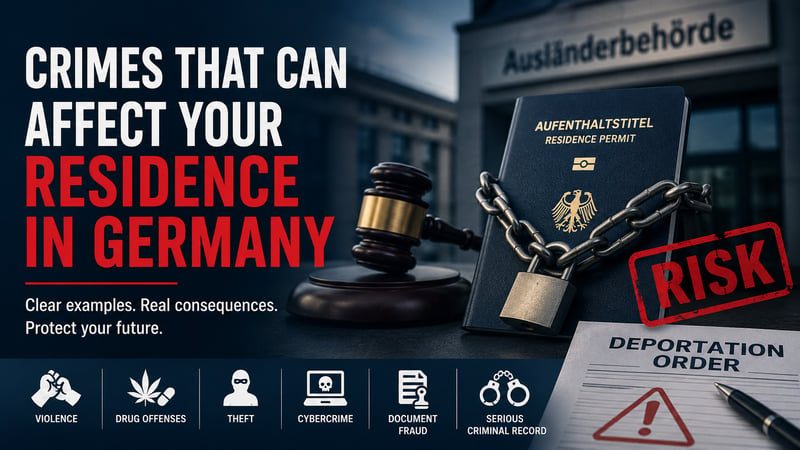
Crimes That Can Lead to Residence Problems or Deportation from Germany
Оновлено Jul 5, 2026
Мова статтіEnglish
The Impact of Criminal Records on Residence Permits, Permanent Residency, and German Citizenship
Introduction
Human beings are naturally capable of making mistakes, and throughout life people usually learn from their errors and try to improve themselves, both in their personal and social lives.
However, some mistakes are considered crimes under the law and may result in legal penalties for the offender. For migrants in Germany, this can mean not only fines or imprisonment, but also immigration-related consequences such as problems with residence permits, rejection of citizenship applications, or even deportation from Germany in serious cases.
Although fear of losing important rights can discourage people from committing acts that may harm society, unnecessary and long-term fear can also negatively affect a person psychologically and create personal and social problems.
This article aims to familiarize migrants with the types of crimes that may affect their citizenship applications or place them at risk of deportation from Germany.
⸻
What Is a Criminal Record and How Is It Checked?
In Germany, a criminal record certificate is called a Führungszeugnis. Any person can request this certificate from the local municipal office (Bürgeramt) in their city of residence and, after paying a fee, receive information about their judicial record.
In many situations — such as applying for a new job, extending a residence permit, and similar procedures — employers or immigration officers may ask the applicant to provide a criminal record certificate in order to review the person’s background.
However, it is important to understand which offenses appear on the criminal record and for how long they remain visible.
First of all, as long as a person has not been finally convicted by a court, the conviction will not appear in the criminal record. Therefore, if a criminal case is still ongoing and no final judgment has been issued, no negative entry will appear in the person’s criminal record certificate.
Minor penalties — for example, a first conviction involving less than 90 daily penalty units or imprisonment of less than three months — usually do not appear in a standard Führungszeugnis if the person has no other criminal history.
More serious convictions, such as long prison sentences, violent crimes, or sexual offenses, are generally recorded and may remain on the criminal record for years depending on the type of offense and punishment. Some very serious crimes may remain in judicial records for a very long time.
⸻
Important Note About “Tagessätze” in Germany
In Germany, judges may sometimes impose a financial penalty instead of imprisonment. This means that instead of serving a suspended or custodial sentence, the offender must pay a monetary fine.
This type of fine is called Tagessätze in German.
Although financial penalties also exist in many other countries, Germany uses a different system: the amount is not fixed, but depends on the person’s daily income.
General Formula
Number of Tagessätze × Daily Income = Total Fine
⸻
Simple Example
Suppose the court calculates a person’s daily income as:
50 euros per day.
If the court imposes:
30 Tagessätze
then:
30 × 50 = 1,500 euros
This means the final fine will be 1,500 euros.
⸻
Second Example
If a person earns more money, the fine also becomes higher.
For example:
* Daily income: 100 euros
* Sentence: 90 Tagessätze
90 × 100 = 9,000 euros
This means the offender must pay a fine of 9,000 euros.
As mentioned earlier, convictions involving around 90 Tagessätze or more can seriously affect residence permits and citizenship applications.
⸻
Which Crimes Can Affect a Migrant’s Residence Status?
According to Section 53 of the German Residence Act:
§ 53 Aufenthaltsgesetz (AufenthG)
Legal Text
„Ein Ausländer wird ausgewiesen, wenn sein Aufenthalt die öffentliche Sicherheit und Ordnung, die freiheitliche demokratische Grundordnung oder sonstige erhebliche Interessen der Bundesrepublik Deutschland gefährdet.“
⸻
Translation
“A foreign national may be deported from Germany if their presence endangers public security and order, the free democratic constitutional order, or other significant interests of the Federal Republic of Germany.”
⸻
Simple Explanation
If the German authorities determine that a person poses a danger to society or repeatedly violates the law, they may:
* refuse to extend the person’s residence permit,
* or issue a deportation order.
⸻
Does Every Crime Lead to Deportation?
No. Not every offense results in deportation.
Immigration authorities always consider:
* the seriousness of the crime,
* the number of offenses,
* the person’s behavior after the offense,
* and the level of danger posed to society.
However, some offenses are considered particularly serious and may create major immigration problems.
⸻
Violent Crimes
Violent offenses are treated very seriously in Germany.
For example:
* assault,
* street fights,
* threats,
* domestic violence,
* or attacks on others
can negatively affect residence status.
⸻
Real-Life Example
Imagine two people get into a fight at a party or on the street and one person hits the other.
Even if the injury is not severe:
* the police may become involved,
* a criminal complaint may be filed,
* and a criminal record may be created.
If the offender is a migrant, this may later create problems during:
* residence permit extensions,
* or citizenship applications.
⸻
Drug-Related Crimes and Residence Status
Drug-related offenses are highly sensitive in Germany.
Example
If a person:
* sells drugs,
* possesses a large quantity of drugs,
* or participates in drug distribution,
they may:
* receive a prison sentence,
* put their residence permit at risk,
* or even face deportation.
Even smaller drug-related offenses can create problems in citizenship applications.
⸻
Theft and Shoplifting
In Germany, theft does not only mean large-scale stealing.
Even:
* shoplifting,
* using public transportation without a ticket,
* or taking someone else’s belongings
may be considered criminal offenses.
⸻
Example
A person leaves a store without paying for an item.
Even if the item has little value:
* the store may call the police,
* a criminal case may be opened,
* and a criminal record may result.
Some migrants think:
“Because the amount was small, it doesn’t matter.”
However, even such incidents can negatively affect immigration cases.
⸻
Internet Crimes and Social Media
In Germany, online behavior also has legal consequences.
Example
A person uses WhatsApp or Instagram to:
* threaten others,
* insult people,
* or publish someone’s private photos.
As a result:
* a criminal complaint may be filed,
* the police may investigate,
* and a criminal record may be created.
Screenshots of messages can be used as evidence.
⸻
Hate Speech and Extremist Content
Germany is highly sensitive regarding:
* racism,
* hate speech,
* promotion of violence,
* and extremist content.
Example
A person posts hateful messages against an ethnic or religious group on social media or shares extremist violent content.
This may:
* constitute a criminal offense,
* and create serious problems for residence permits or citizenship applications.
⸻
Fake Documents and Lies in Immigration Cases
One of the most dangerous mistakes migrants can make is:
* using fake documents,
* or providing false information.
⸻
Example
A person:
* submits fake salary statements,
* uses a forged language certificate,
* or lies about their family situation.
If immigration authorities discover this:
* the residence application may be rejected,
* criminal proceedings may begin,
* or the residence permit may even be revoked.
⸻
What Should You Do If You Have a Criminal Case?
In such situations:
* do not ignore letters from the police or courts,
* do not sign anything without proper advice,
* and consult a specialized lawyer if necessary.
Some people create much larger immigration problems for themselves simply because they ignore legal procedures.
⸻
Important Warning for Migrants
Some migrants believe:
“If I make only one mistake, it won’t matter.”
But in Germany:
* respect for the law,
* social behavior,
* and criminal history
can affect for many years:
* residence permits,
* permanent residence,
* and citizenship applications.
⸻
Final Conclusion
Although having a criminal record does not always mean the end of a migrant’s future in Germany, ignoring laws and judicial matters can create serious and long-term consequences.
For a safer future in Germany:
✔ Avoid violence and physical conflicts
✔ Behave responsibly online
✔ Never use fake documents
✔ Take German laws seriously
✔ Act quickly if you face legal problems
In Germany, a criminal record is not just a court matter; it can also affect a person’s entire immigration future.
⸻
✔ Respect for the law
✔ Responsibility
✔ Respect for society
These three principles form the foundation of a safe and successful life as a migrant in Germany.