Ładowanie
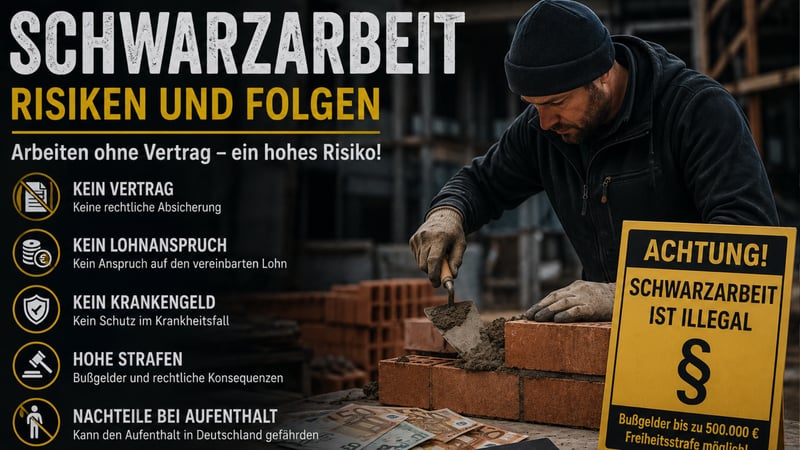
Illegal Work (Schwarzarbeit) in Germany
Zaktualizowano Jul 5, 2026
Język artykułuEnglish
Illegal Employment, Tax Evasion, Penalties, and Serious Risks for Migrants
⸻
Introduction
Many migrants who newly arrive in Germany soon become familiar with the term Schwarzarbeit, meaning illegal or undeclared work.
First, it is important to define what Schwarzarbeit actually means.
Schwarzarbeit refers to work performed without legal registration.
This means:
working or employing someone without official declaration, without paying taxes, without insurance coverage, and without registration in Germany’s legal system.
Some people think that if they do not pay taxes, work without a contract, or receive wages in cash, there is no major problem.
However, in Germany, Schwarzarbeit is treated very seriously and can create severe legal problems for employees, employers, and even for the immigration status of migrants.
Many migrants enter informal work without fully understanding the law, but later face financial penalties, insurance problems, loss of legal rights, or even risks to their residency status.
This article is a simple and practical guide to the concept of Schwarzarbeit, the related laws, and its major risks in Germany.
⸻
Important Note About Zoll Inspections
You should know that if officers from the German customs authority (Zoll), who are responsible for detecting illegal work, discover an undocumented worker at a workplace (meaning a worker without a legal employment contract), they may open legal cases against both the worker and the employer.
This is based on:
§ 1 Schwarzarbeitsbekämpfungsgesetz (SchwarzArbG)
Text of the Law
„Schwarzarbeit leistet, wer Dienst- oder Werkleistungen erbringt oder ausführen lässt und dabei
als Arbeitgeber, Unternehmer oder versicherungspflichtiger Selbstständiger seine sich aufgrund der Dienst- oder Werkleistungen ergebenden sozialversicherungsrechtlichen Melde-, Beitrags- oder Aufzeichnungspflichten nicht erfüllt,
als Steuerpflichtiger seine sich aufgrund der Dienst- oder Werkleistungen ergebenden steuerlichen Pflichten nicht erfüllt,
als Empfänger von Sozialleistungen seine sich aufgrund der Dienst- oder Werkleistungen ergebenden Mitteilungspflichten gegenüber dem Sozialleistungsträger nicht erfüllt.“
⸻
Translation
“A person performs illegal work if they provide or commission services or work while:
* as an employer, entrepreneur, or insured self-employed person, failing to fulfill obligations regarding social insurance registration, contributions, or documentation,
* failing to fulfill tax obligations,
* or, while receiving social benefits, failing to report income from such work to the social welfare authorities.”
⸻
Both the worker who agrees to work without a legal contract and the employer who hires workers without legal registration may face fines or legal prosecution.
The legal treatment of the two cases may differ, but both parties can face penalties or legal consequences.
In this section, we will first discuss how the law treats employers who hire undocumented workers, and then explain the consequences of Schwarzarbeit for workers, especially migrant workers.
⸻
Is Every Cash Payment Illegal?
No.
Receiving wages in cash is not automatically illegal.
In practice, cash payments alone are not unlawful, as long as the income is officially declared and taxes and insurance contributions are properly paid.
The problem arises when:
the work is not registered,
taxes are not paid,
there is no insurance coverage,
or the relevant authorities are unaware of the employment.
⸻
Simple Example
Imagine a person working in a restaurant, on a construction or renovation site, in a hair salon, or in cleaning services, but:
* they have no contract,
* no insurance,
* and they secretly receive cash payments.
In many cases, this situation is considered Schwarzarbeit.
⸻
“Half Legal, Half Illegal” Employment
Some employers hire workers partly legally and partly illegally.
For example:
they officially register a 20-hour work contract and pay taxes and insurance for only 20 hours per week, but require the worker to actually work 40 hours and pay the remaining wages unofficially in cash.
Although proving this can be difficult for authorities, it is not impossible.
If it is proven that an employer intentionally used such methods to conceal illegal work, the employer may face much harsher penalties.
⸻
Penalties for Schwarzarbeit in Germany
Many people believe Schwarzarbeit is only a minor offense.
However, in some cases criminal proceedings may be initiated, and very heavy financial penalties or even imprisonment may result.
⸻
Important Legal Provision About Fines
§ 8 SchwarzArbG – Bußgeldvorschriften
Text of the Law
„Ordnungswidrig handelt, wer vorsätzlich oder fahrlässig einer Vorschrift dieses Gesetzes zuwiderhandelt.“
⸻
Translation
“Anyone who intentionally or negligently violates the provisions of this law commits an administrative offense.”
⸻
How High Can the Fine Be?
Depending on the violation, fines can range from several hundred euros to €50,000 or even more.
In some cases, where the matter becomes a criminal investigation, individuals or companies may face charges such as:
* tax evasion,
* social benefit fraud,
* or large-scale labor exploitation.
⸻
What Happens if Taxes Were Not Paid?
The tax office (Finanzamt) can demand unpaid taxes, together with tax penalties and interest.
⸻
Example
Imagine an employer hires several workers illegally without registration, pays no insurance, submits no taxes, and pays wages in cash.
If an inspection takes place:
the employer may face thousands of euros in fines, tax debts, and even criminal charges.
⸻
Can the Worker Also Be Punished?
Yes.
Some migrants think only the employer is responsible.
However, if a person knowingly works without legal registration, improperly receives social benefits, or hides income, they may also face fines, criminal proceedings, or residency problems.
⸻
Receiving Social Benefits While Working Illegally
This is one of the most sensitive issues in Germany.
If a person receives government support such as unemployment benefits or social welfare while also earning undeclared income, they may be prosecuted for social fraud.
In addition to financial penalties, they may lose access to certain social benefits.
If the person is a migrant, they may also face difficulties when renewing their residence permit.
For example:
* a permanent residency application may be rejected,
* or a citizenship application may be negatively affected.
Furthermore, because illegal workers are not properly insured, if an accident occurs at work, they may not be able to use work insurance benefits or successfully claim compensation, disability support, or medical expenses from the employer.
⸻
Example
Imagine a worker illegally employed on a construction site falls from scaffolding or suffers a serious injury.
In such situations:
* obtaining compensation,
* receiving insurance support,
* or proving the employment relationship
may become extremely difficult.
The worker may face not only serious physical harm but also a complicated legal process.
⸻
Common Mistakes by Migrants
Some people:
* start working without a contract,
* rely only on verbal promises,
* or think that “a few months of illegal work is not a problem.”
But later they discover that:
* they do not receive their wages,
* they have no insurance,
* or they face immigration problems.
⸻
Important Warning
Some employers tell migrants:
“Everything is okay, no problem will happen.”
But if problems arise:
the worker is usually the most vulnerable person, especially if they are a migrant and do not have sufficient knowledge of the German language or German law.
⸻
Final Conclusion
For a secure future in Germany:
✔ Work only legally
✔ Always have a work contract
✔ Take insurance and taxes seriously
✔ Do not work without official registration
✔ Do not fully trust unofficial promises
In Germany, illegal work may appear easy in the short term, but in the long term it can create very serious financial, legal, and immigration problems.
✔ Job security
✔ Insurance and legal protection
✔ A secure immigration future
These are the three most important reasons to avoid Schwarzarbeit in Germany.