Ładowanie
Child Custody and Parents’ Rights in Germany
Zaktualizowano Jul 5, 2026
Język artykułuEnglish
Child Visitation Rights and the Role of the Jugendamt
⸻
Introduction
One of the most sensitive and important topics in German family law is child custody and parental rights.
Many migrants living in Germany encounter terms such as Sorgerecht, Umgangsrecht, Jugendamt, and Familiengericht after divorce, separation, family disputes, or problems related to their children.
However, many people do not fully understand what custody means in Germany, who has the authority to make decisions about a child, what role parents play in raising their children, and when the court or the Jugendamt become involved.
Within migrant communities, there is also a great deal of misinformation and fear regarding this issue. Some people believe that “if a family dispute occurs, the Jugendamt will immediately take the child away from the family.” In reality, the legal situation is much more complex and very different from these assumptions.
This article is a simple and practical guide to child custody, parental rights, and the role of legal institutions in Germany.
⸻
What Is Child Custody in Germany?
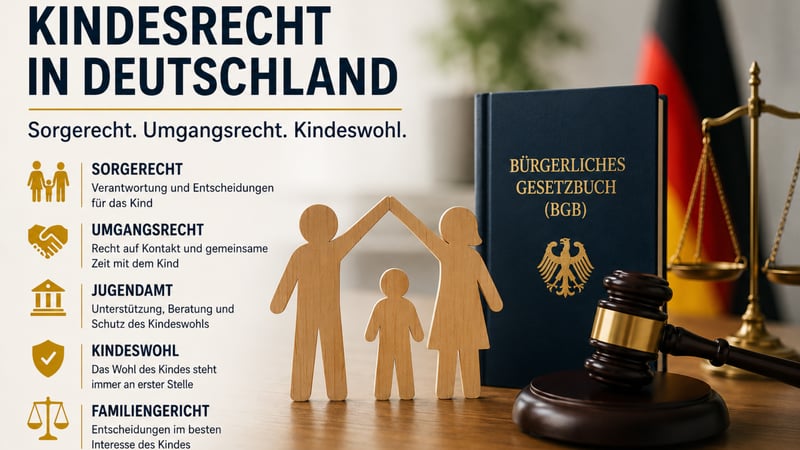
In Germany, Sorgerecht means the legal right and responsibility of parents toward their child.
This issue is not limited to where the child lives; it also includes decisions about:
* education,
* health care,
* school,
* medical treatment,
* place of residence,
* and other important aspects of the child’s life.
⸻
Important Legal Provision
§ 1626 BGB – Parental Custody
Text of the Law
„Die Eltern haben die Pflicht und das Recht, für das minderjährige Kind zu sorgen (elterliche Sorge).“
Translation
“The parents have both the duty and the right to care for their minor child (parental custody).”
⸻
What Is the Main Goal of the Law?
In Germany, the most important principle in family law cases is the Kindeswohl, meaning the child’s welfare and best interests.
This means that courts and authorities first examine what is best and safest for the child and which conditions support the child’s healthy development.
⸻
Does Custody End After Divorce?
No.
Even after divorce, both parents may continue to share custody rights. This is called Gemeinsames Sorgerecht (joint custody).
⸻
What Is the Difference Between Custody and Visitation Rights?
Many people confuse these two concepts.
* Sorgerecht means the legal right to make decisions about the child’s life.
* Umgangsrecht means the right to have contact and visitation with the child.
After separation, the child may primarily live with one parent, but the other parent usually still has the right to maintain contact and a relationship with the child.
In Germany, after separation or divorce, joint custody often continues. This means both parents remain involved in important decisions regarding the child’s life.
The family court usually makes decisions based on:
* the child’s best interests (Kindeswohl),
* living conditions,
* the parents’ ability to care for the child,
* and the child’s safety and emotional stability.
For this reason, German law does not automatically grant custody only to the mother or only to the father. Each case is examined individually according to the real circumstances of the family.
In some situations, however, the child may mainly live with one parent, or sole custody may be granted to one parent. Such decisions require legal review or a court ruling.
⸻
What Happens If Parents Disagree?
If parents disagree about issues such as:
* where the child should live,
* school,
* travel,
* medical treatment,
* or other important matters,
the Familiengericht (Family Court) may make the final decision.
⸻
What Is the Role of the Jugendamt?
One of the most important family-related institutions in Germany is the Jugendamt (Youth Welfare Office).
Its role is to:
* support children,
* assist families,
* and protect the child’s safety and well-being.
⸻
Is the Jugendamt an Enemy of Families?
Many migrants are afraid of the Jugendamt.
In reality, the primary goal of this institution is usually to support children and help families — not to separate children from their parents.
⸻
When Does the Jugendamt Become Involved?
For example, the Jugendamt may become involved in cases of:
* domestic violence,
* child abuse,
* severe neglect,
* serious addiction problems,
* or significant danger to the child’s well-being.
⸻
Can the Jugendamt Remove a Child From the Family?
In very serious situations, yes.
However, this decision is usually not simple, immediate, or made without legal review.
In many cases, authorities first try to help the family, provide counseling, and improve the situation before considering removal of the child.
⸻
Fathers’ Rights in Germany
Some migrants believe that “custody in Germany is always given to the mother.”
This is incorrect.
In many cases, fathers also have extensive legal rights, and courts generally try to preserve the child’s relationship with both parents.
⸻
What Happens If One Parent Prevents Contact?
If one parent prevents the child from seeing the other parent without a valid legal reason:
* the court may intervene,
* or custody arrangements may be changed.
⸻
Domestic Violence and Custody
If there is violence, threats, or serious danger, visitation rights may be restricted, or the court may impose protective measures.
In Germany, the child’s safety is considered a very high priority.
⸻
Traveling Abroad With a Child
In some cases, both parents’ consent is required for:
* travel,
* relocation,
* migration,
* or changing the child’s residence abroad.
If there is disagreement, the court may decide.
⸻
The Effect of Criminal Cases on Custody
If one parent commits:
* violence,
* abuse,
* severe addiction-related offenses,
* or dangerous crimes,
this may affect custody rights or visitation rights.
⸻
Common Mistakes Made by Migrants
Some people use the child as a tool to pressure the other parent, take the child out of Germany without permission, or believe that the law only supports one side.
However, in Germany, the child’s welfare and emotional and social stability are considered far more important than the parents’ conflicts.
⸻
Important Warning
In family cases, emotional decisions, threats, or severe conflicts can affect:
* custody rights,
* residence permits,
* and even the child’s future.
⸻
Final Conclusion
To protect your rights and your child’s rights in Germany:
✔ Stay calm and act legally
✔ Do not involve the child in parental conflicts
✔ Learn your legal rights
✔ Avoid rushed decisions
✔ Seek professional advice in complicated cases
In Germany, family law aims to protect the child, preserve healthy relationships between parents and children, and ensure the child’s emotional and social security.
✔ Parental responsibility
✔ The child’s emotional well-being
✔ Respect for the law
These three principles form the foundation of decision-making in many family law cases in Germany.