Loading
Germany’s Opportunity Card (Chancenkarte): What Is It, Who Can Apply, and Are You Allowed to Work?
Updated on Nov 21, 2026
Reviewed by a lawyer
Germany has introduced a new immigration pathway to attract skilled workers from countries outside the European Union. This pathway is called the Opportunity Card (Chancenkarte).
The Opportunity Card allows eligible individuals to enter Germany without having a job contract in advance and search for suitable employment after arriving in the country.
But what exactly is the Opportunity Card? Who can apply? What are the requirements? And are you allowed to work in Germany with this residence permit?
1. What Is the German Opportunity Card?
The German Opportunity Card was introduced in June 2024. Its main purpose is to make it easier for qualified workers from non-EU countries to enter Germany and look for employment.
With the Opportunity Card, eligible applicants can stay in Germany for up to one year while searching for a suitable job.
One of its biggest advantages is that you generally do not need to have an employment contract with a German company before applying.
2. What Are the Requirements for the Opportunity Card?
There are two main ways to qualify for the Opportunity Card.
First Option: A Recognized University Degree or Professional Qualification
If your university degree or professional qualification is fully recognized in Germany, you can apply for the Opportunity Card as a skilled worker (Fachkraft).
In this case, you do not need to collect six points under the points-based system.
Second Option: The Points-Based System
If your qualification is not fully recognized in Germany, you may still be eligible to apply through the points-based system.
To qualify, you must have a recognized university degree or a professional qualification that involved at least two years of training and is officially recognized in the country where you obtained it.
You must also meet at least one of the following language requirements:
German language skills at least at A1 level, or
English language skills at least at B2 level.
In addition, you must collect at least six points under the points-based system.
3. How Does the Opportunity Card Points System Work?
Points are awarded based on several criteria:
Under 35 years of age: 2 points.
Between 35 and under 40 years of age: 1 point.
German language skills at B2 level or higher: 3 points.
German language skills at B1 level: 2 points.
German language skills at A2 level: 1 point.
English language skills at C1 level or higher: 1 point.
At least five years of relevant work experience within the last seven years: 3 points.
At least two years of relevant work experience within the last five years: 2 points.
Qualification in an occupation experiencing a skills shortage in Germany: 1 point.
Partial recognition of your professional qualification by a German authority: 4 points.
At least six months of legal residence in Germany within the last five years: 1 point.
Your spouse or registered partner also applies for an Opportunity Card and meets the relevant requirements: 1 point.
You must obtain at least six points to qualify through this pathway.
4. How Much Money Do You Need for the Opportunity Card?
One important requirement is proving that you can financially support yourself during your stay in Germany.
The stated financial requirement for 2026 is €1,091 per month. For a 12-month stay, this amounts to approximately €13,092.
You can generally demonstrate your financial resources through one of the following options:
A blocked bank account (Sperrkonto).
An official declaration of financial commitment (Verpflichtungserklärung) from a person in Germany who has sufficient financial resources.
Under certain conditions, income from part-time employment in Germany.
5. What Documents Are Required to Apply?
The documents generally required for an Opportunity Card application include:
A valid passport.
A completed national visa application form.
A biometric passport photograph.
An up-to-date CV.
University degree or professional qualification certificates.
Proof of previous work experience.
Proof of German or English language skills.
Evidence of sufficient financial resources.
Valid health insurance.
Documents confirming the recognition or assessment of your qualifications, if required.
The exact requirements may vary depending on the country where you apply and the responsible German embassy or consulate. Applicants should therefore check the latest requirements before submitting their applications.
6. Are You Allowed to Work in Germany with the Opportunity Card?
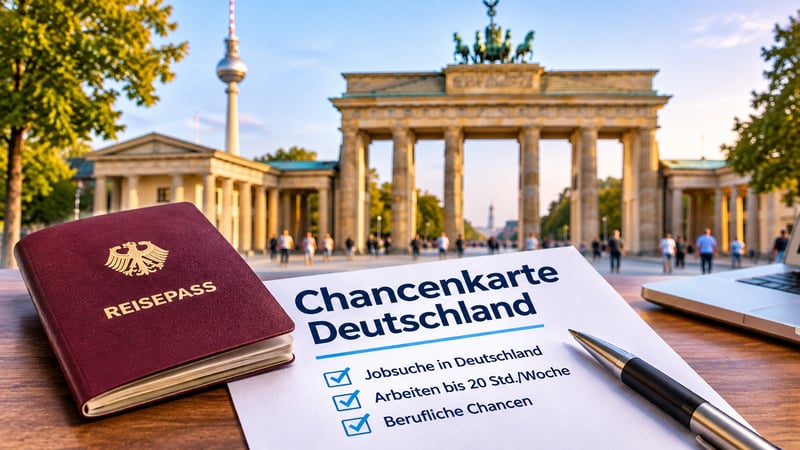
Yes. One of the major advantages of the Opportunity Card is that you are allowed to work while searching for a suitable full-time position.
Holders of the Opportunity Card can work part-time for up to 20 hours per week.
This employment does not necessarily have to be related to your university degree or professional qualification.
Examples of possible jobs include:
Working in restaurants and cafés.
Employment in retail stores.
Jobs in the service sector.
Administrative and office work.
Positions in companies and organizations.
Can You Work Full-Time with the Opportunity Card?
The Opportunity Card itself does not grant permission to work full-time.
However, if you find a suitable qualified job during your stay, you can apply to the responsible immigration authority (Ausländerbehörde) to change your residence status to a work-related residence permit.
Once the new residence permit has been approved and issued, you may work full-time according to the conditions of that permit.
Is Trial Employment (Probearbeit) Allowed?
Yes. Opportunity Card holders may undertake a trial period of up to two weeks with each employer.
However, this must meet specific legal requirements and be related to qualified employment, vocational training, or measures aimed at obtaining recognition of a professional qualification.
7. What Happens If You Do Not Find a Job Within One Year?
The Opportunity Card is generally issued for a maximum period of twelve months.
Under certain legal conditions, it may be possible to extend the stay for up to two additional years.
For example, an applicant may qualify if they have received a binding job offer for qualified employment but do not yet meet the requirements for another type of work-related residence permit.
This extension is known as the Follow-up Opportunity Card (Folge-Chancenkarte).
The extension is not automatic. The responsible immigration authority must examine and approve the application.
Conclusion
The German Opportunity Card offers qualified individuals from countries outside the European Union an additional opportunity to enter Germany and access the German labor market.
One of its main advantages is that applicants do not necessarily need to have an employment contract before entering Germany.
However, receiving an Opportunity Card does not guarantee employment or automatically lead to permanent residence.
Applicants should carefully assess their educational qualifications, professional experience, language skills, and financial resources before applying.
For more information about migration, employment, living in Germany, and legal matters, visit the Siyavash information platform.
Sources and Official Information
Make it in Germany – Official information about the Opportunity Card:
https://www.make-it-in-germany.com/en/visa-recognition/opportunity-card
German Federal Foreign Office – Official visa application portal:
https://digital.diplo.de/chancenkarte
German Residence Act – Section 20a (Opportunity Card):
https://www.gesetze-im-internet.de/aufenthg_2004/__20a.html
Federal Employment Agency (Bundesagentur für Arbeit):
https://www.arbeitsagentur.de/