Loading
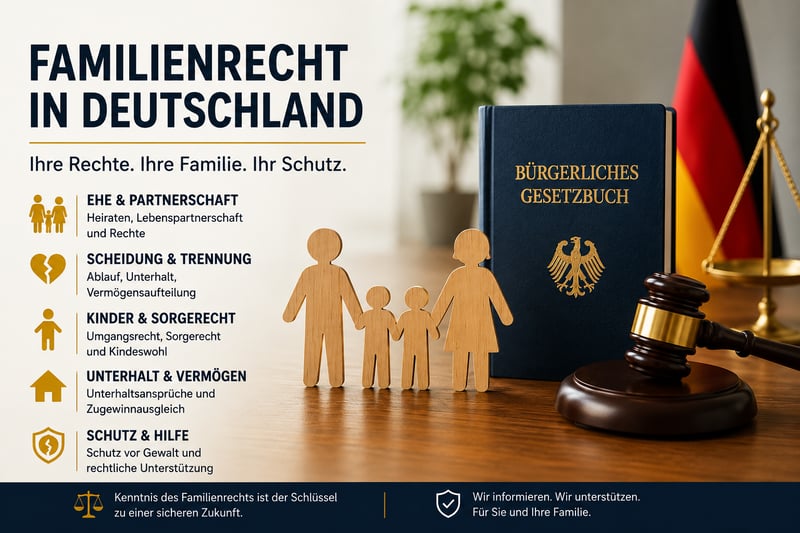
An Introduction to Family Law in Germany
Updated on Jul 5, 2026
Article languageEnglish
Marriage, Divorce, Child Custody, Family Rights, and Legal Protection
⸻
Introduction
Family is one of the most important parts of every person’s life, and for this reason, family laws in Germany are highly significant.
Many migrants living in Germany will sooner or later encounter issues such as:
* marriage,
* divorce,
* child custody,
* alimony and financial support,
* family-based residence permits,
* domestic violence,
* or the rights of parents and children.
However, many people at the beginning of their journey are not fully familiar with German family law, and this lack of knowledge can sometimes lead to legal, family-related, or immigration problems.
In Germany, family law is not only about marriage and divorce; rather, it is a collection of laws designed to protect the rights of family members, define parental responsibilities, and help preserve the safety and stability of the family.
This article is a general introduction to the most important principles of family law in Germany. In future articles, each topic will be discussed separately and in greater detail.
⸻
What Is Family Law in Germany?
A large part of German family law is contained in the Bürgerliches Gesetzbuch (BGB), also known as the German Civil Code.
These laws regulate matters such as:
* marriage,
* divorce,
* child custody,
* alimony,
* inheritance,
* and parental responsibilities.
⸻
The Role of the Family Court
In Germany, many family disputes are handled by the Familiengericht (Family Court).
This court makes decisions regarding issues such as:
* divorce,
* child custody,
* visitation rights,
* alimony,
* and certain other family-related disputes.
⸻
Marriage in Germany
Marriage in Germany is not only considered an emotional relationship, but also a legal relationship.
For a marriage to become officially recognized, it generally must be registered at the Standesamt (civil registry office), official identification documents must be provided, and all legal requirements must be fulfilled.
⸻
Is a Religious Marriage Alone Sufficient?
No.
Only a marriage that has been officially and legally registered is considered valid by the German state.
Therefore:
* a religious marriage ceremony,
* or a traditional ceremony,
without official registration usually does not create full legal rights.
⸻
Divorce in Germany
If a marital relationship can no longer continue, legal divorce is possible.
However, in Germany, divorce is not considered a simple separation. Important issues such as child custody, division of assets, alimony, the child’s place of residence, and financial support may also arise.
⸻
The Year of Separation (Trennungsjahr)
In many divorce cases, spouses are first required to live separately for one year.
This period is called the Trennungsjahr (year of separation).
The purpose of this law is to provide enough time for reflection and the possibility of reconciliation.
⸻
Child Custody in Germany
One of the most sensitive areas of family law is Sorgerecht, meaning custody and parental responsibility.
In Germany, the court generally considers the child’s best interests to be the most important factor when making decisions.
⸻
Do Both Parents Have Rights After Divorce?
In many cases, yes.
Even after divorce, both parents may continue to have a role in making important decisions regarding the child.
⸻
Alimony and Financial Support
In certain situations, one parent or one spouse may be required to pay Unterhalt (financial support or alimony).
The amount of support depends on factors such as:
* income,
* financial circumstances,
* the number of children,
* and living conditions.
⸻
Domestic Violence in Germany
Germany takes physical violence, threats, psychological abuse, and domestic violence very seriously.
In some situations, the police can remove the violent individual from the home, or the court can issue protective orders.
According to Section 1 of the Protection Against Violence Act:
§ 1 GewSchG – Judicial Measures for Protection Against Violence and Stalking
Text of the Law
„Hat eine Person vorsätzlich den Körper, die Gesundheit oder die Freiheit einer anderen Person widerrechtlich verletzt, kann das Gericht die zur Abwendung weiterer Verletzungen erforderlichen Maßnahmen treffen.
Das Gericht kann insbesondere anordnen, dass der Täter es unterlässt,
die Wohnung der verletzten Person zu betreten,
sich in einem bestimmten Umkreis der Wohnung aufzuhalten,
zu bestimmende andere Orte aufzusuchen, an denen sich die verletzte Person regelmäßig aufhält,
Verbindung zur verletzten Person aufzunehmen, auch unter Verwendung von Fernkommunikationsmitteln,
Zusammentreffen mit der verletzten Person herbeizuführen.“
⸻
Translation
“If a person intentionally and unlawfully injures another person’s body, health, or freedom, the court may take the measures necessary to prevent further harm.
In particular, the court may order the offender to refrain from:
* entering the injured person’s home,
* remaining within a specified distance of the residence,
* visiting places regularly frequented by the injured person,
* contacting the injured person, including by telephone, messages, or internet communication,
* or arranging meetings or encounters with the injured person.”
⸻
Simple Explanation
According to this law, if a person threatens someone, commits domestic violence, continuously harasses another person, or causes fear and insecurity, the court can quickly issue:
* a restraining order,
* a no-contact order,
* or even an order removing the violent person from the shared home.
⸻
Simple Example
If someone:
* constantly sends threatening messages,
* appears in front of another person’s home or workplace,
* or continues harassment after separation,
the victim can request legal protection from the court under the GewSchG.
⸻
Children’s Rights in Germany
In Germany, children’s rights are taken very seriously.
The state aims to protect:
* the child’s safety,
* health,
* education,
* and overall well-being.
In certain situations, the Jugendamt (Youth Welfare Office) may also become involved.
⸻
Family-Based Residence Permits
For many migrants, family matters are directly connected to residence status.
For example, marriage, divorce, custody disputes, or domestic violence may affect:
* residence permit extensions,
* permanent residence,
* or citizenship applications.
⸻
Common Mistakes Made by Migrants
Some people do not take family law seriously, sign documents without fully understanding them, or assume that the law does not interfere in family matters.
In practice, however, there are many important legal differences and consequences.
⸻
Important Warning
In family-related matters, emotional decisions, violence, or ignoring the law can lead to serious legal, financial, and even immigration-related consequences.
⸻
Final Conclusion
To have a safe and lawful family life in Germany:
✔ Take family laws seriously
✔ Be aware of your legal rights
✔ Do not rush important decisions
✔ In disputes, act calmly and legally
✔ In complex situations, seek professional advice
In Germany, family law is not only about resolving disputes; its purpose is also to protect:
* family security,
* children’s rights,
* and social stability.
✔ Legal awareness
✔ Mutual respect
✔ Family responsibility
These three principles are the foundation of a safe and healthy family life in Germany.