Nitroglycerin: How a Highly Explosive Substance Became a Heart Medication
You know the medication – but do you know its history?
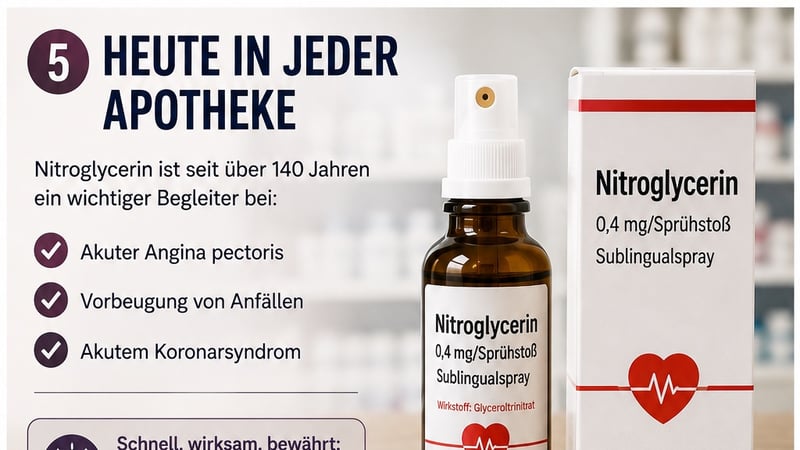
For many people with angina pectoris, a small nitro spray is part of everyday life. A spray under the tongue – and the active ingredient can unfold its vasodilating effect within a short time.
But behind this unassuming medicine lies a story that goes back almost 180 years. It leads from an Italian chemical laboratory, via Alfred Nobel and the development of dynamite, to modern cardiac medicine.
And it begins with a substance that even its discoverer had great respect for.
1847: The Discovery of Nitroglycerin
The Italian chemist **Ascanio Sobrero** first produced nitroglycerin in 1847. More precisely, chemically, we now speak of glycerol trinitrate (GTN).
Sobrero quickly realized that he was dealing with an extraordinary substance: nitroglycerin was extremely sensitive and highly explosive.
But it also showed another effect.
Already in early experiments, it became clear that contact with nitroglycerin could cause severe, pulsating headaches.
What was probably primarily unpleasant at the time was an initial indication of the substance's pronounced effect on the human vascular system.
However, no one yet knew the mechanism behind it.
And then came Alfred Nobel
A frequently told story needs to be corrected at this point:
Alfred Nobel did not invent nitroglycerin.
When Nobel began to work with the substance, it was already known.
His great achievement was to develop ways to make nitroglycerin technically more manageable. In 1867, Nobel patented dynamite.
Dynamite and nitroglycerin are therefore not the same thing. Nitroglycerin was an essential component of the original dynamite formulation.
While the substance revolutionized industry and blasting technology, a completely different story developed in parallel.
Medicine began to take an interest in its effect on human circulation.
1879: Nitroglycerin Becomes a Medicine
The British physician, William Murrell, investigated nitroglycerin in patients with angina pectoris.
In 1879, he published his observations in the medical journal "The Lancet".
Angina pectoris refers to paroxysmal symptoms, typically pressure, tightness, or pain in the chest, which can occur when there is an imbalance between the oxygen supply and oxygen demand of the heart muscle.
Murrell observed that nitroglycerin could relieve such symptoms.
The remarkable thing about it:
Medicine successfully used nitroglycerin, although its current molecular mechanism of action was not known for a long time.
How Does Nitroglycerin Actually Work?
Today, we understand much better what happens in the body after the administration of glycerol trinitrate.
GTN must first be bioactivated. Through several steps, bioactive nitric oxide-related species are formed or act. Signal transduction leads to the activation of soluble guanylate cyclase and an increase in cGMP in the smooth vascular muscle.
Simply put:
The vascular muscles relax and the blood vessels widen.
For the effect in angina pectoris, the dilation of the venous vessels is particularly important.
This means less blood returns to the heart. The so-called preload of the heart decreases, wall tension can diminish, and the heart requires less oxygen.
Therefore, the frequently used explanation "nitroglycerin simply ensures that more blood flows to the heart" would be too simplistic.
A significant part of the effect is rather to relieve the heart and reduce its oxygen demand.
The Perhaps Most Astonishing Twist in the Story
And here a remarkable circle closes.
Alfred Nobel, whose name is inextricably linked with dynamite and the technical use of nitroglycerin, later suffered from angina pectoris himself.
His doctors prescribed him nitroglycerin, of all things.
Nobel himself commented on this situation in his correspondence as an irony of fate.
The substance that had shaped a significant part of his industrial career encountered him again at the end of his life – this time not as an explosive component, but as a medicine.
What We Absolutely Must Mention in the Pharmacy
As fascinating as the story is: for current use, one interaction is particularly important.
Organic nitrates like glycerol trinitrate must not be used together with certain PDE-5 inhibitors.
These include, for example:
- Sildenafil
- Tadalafil
- Vardenafil
- Avanafil
These active ingredients are used, among other things, to treat erectile dysfunction.
Both nitrates and PDE-5 inhibitors interfere with the cGMP system. If they are combined, the blood pressure-lowering effect can be dangerously enhanced.
This can lead to pronounced hypotension and severe circulatory problems.
Therefore, the question in the pharmacy about other medications is not a triviality, and certainly not mere curiosity.
It can be crucial for drug therapy safety.
The active ingredient Riociguat, a stimulator of soluble guanylate cyclase, must also not be combined with nitrates.
Why Nitroglycerin Can Cause Headaches
This brings us back to Sobrero's observations from the 19th century.
Headaches are among the known undesirable effects of nitrates. They are related to their pronounced vasodilating effect.
So what the early chemists noticed on their own bodies was not an insignificant side effect.
It was a visible indication of the molecule's strong biological effect.
Almost 180 Years in a Small Medicine
The history of glycerol trinitrate shows something that is easily forgotten in modern medicine:
Medicines do not always emerge in a straight line.
Sometimes a substance is discovered first.
Then someone observes an unexpected effect.
Doctors begin to use this effect therapeutically.
And only many decades later do scientists understand in detail the biological mechanism behind it.
For nitroglycerin, this path of discovery took more than a century.
Research into nitric oxide as a signaling molecule of the cardiovascular system eventually became so significant that Robert F. Furchgott, Louis J. Ignarro, and Ferid Murad received the Nobel Prize in Physiology or Medicine in 1998 for their discoveries concerning the role of NO in the cardiovascular system.
Thus, the history of nitroglycerin leads from Sobrero, via Nobel and Murrell, into modern molecular pharmacology.
And that's exactly what makes drug history so exciting:
Behind a small package that we take for granted in the pharmacy today can lie decades or even centuries of human observation, errors, scientific curiosity, and research.