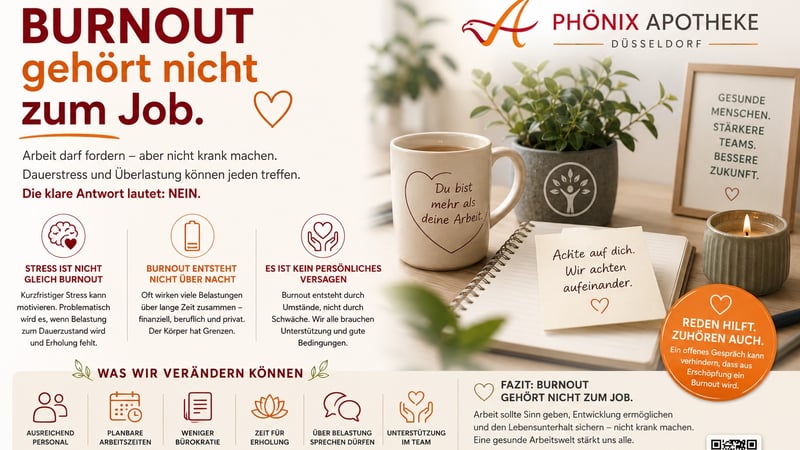
Burnout is not part of the job
“That’s just the job.”
Many people hear this sentence when they report exhaustion, overload, or chronic stress.
But is that really true? Is burnout an unavoidable side effect of professional life?
The clear answer is: No.
Stress is not the same as burnout
Work can be demanding. Challenges are part of almost every profession. Short-term stress can even be motivating and help to cope with difficult situations.
However, it becomes problematic when strain becomes a permanent state and recovery is barely possible. This is where the line to burnout begins to blur.
Burnout does not happen overnight
Burnout is rarely the result of a single stressful day or short-term strain. It usually develops gradually over months or years.
Often, several stressors come together simultaneously, which can reinforce each other:
* Financial worries
* Staff shortages
* Constant availability
* Increasing bureaucracy
* Childcare or caregiving obligations
* Multiple jobs simultaneously
* Lack of recovery phases
When people constantly just function and ignore their own needs, the body eventually reaches its limits – with serious health consequences.
It is not a personal failure
Anyone who develops burnout is not “too weak” or has personally failed. Burnout is a complex reaction to chronic stress.
It often arises where working conditions, societal expectations, and private burdens continuously interact. Therefore, it is not enough to only talk about individual resilience. Equally important is the question of how we can design work in such a way that people remain healthy and do not even get into a burnout spiral.
What can we change?
Healthy working conditions are crucial and include, among other things:
* Sufficient staff for a fair distribution of workload
* Predictable working hours for a better work-life balance
* Less unnecessary bureaucracy to focus on core tasks
* Sufficient time for recovery and breaks
* A culture where overload can be openly discussed and help is offered
* Mutual support and appreciation within the team
Conclusion
Burnout is not part of the job. It is a warning sign that must be taken seriously.
Work should provide meaning, enable personal development, and secure livelihood – not make people sick.
A healthy work environment not only protects employees from overload. It also improves the quality of work, strengthens teams, and ultimately benefits society as a whole.
Therefore: Pay attention to each other. Ask if you notice changes. Listen and offer support. Sometimes an open conversation can prevent exhaustion from turning into burnout.