جارٍ التحميل
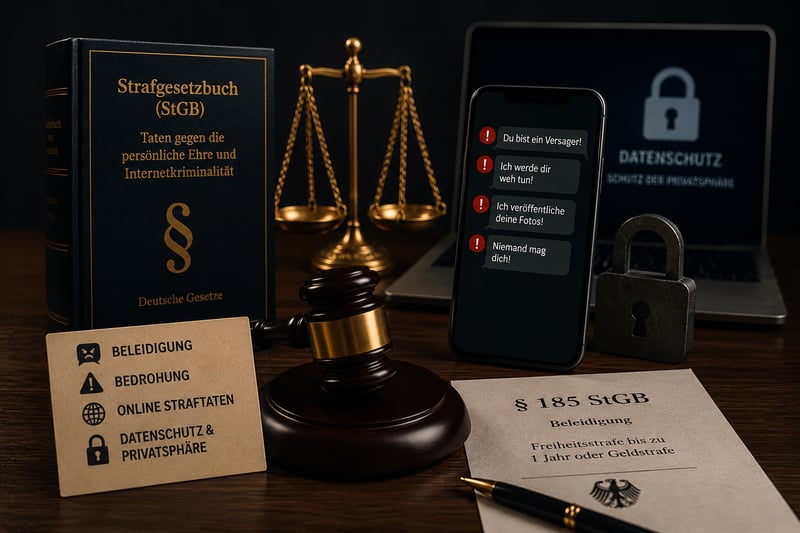
Insults, Threats, and Internet Crimes Under German Law
تم التحديث في Jul 5, 2026
لغة المقالEnglish
Verbal Abuse, WhatsApp Threats, Sharing Images, and Online Harassment
Introduction
In Germany, insults, threats, and certain forms of online behavior are taken very seriously. Many actions that may be considered “normal” or “just a moment of anger” in some countries can be treated as criminal offenses under German law.
This issue is especially important on social media platforms, WhatsApp, Instagram, Telegram, and in workplace environments.
German law protects:
* human dignity,
* privacy,
* psychological safety,
* and the personal lives of individuals.
For this reason:
* verbal abuse,
* threats,
* sharing private images,
* online harassment,
* and hate speech
can all lead to serious legal consequences.
Part One: Insult
§ 185 StGB – Beleidigung (Insult)
Legal Text (German):
„Die Beleidigung wird mit Freiheitsstrafe bis zu einem Jahr oder mit Geldstrafe und, wenn die Beleidigung mittels einer Tätlichkeit begangen wird, mit Freiheitsstrafe bis zu zwei Jahren oder mit Geldstrafe bestraft.“
Translation:
An insult is punishable by imprisonment of up to one year or a fine; if the insult is committed through physical conduct, the punishment may be imprisonment of up to two years or a fine.
Simple Explanation
In Germany, verbal abuse and insults can be criminal offenses.
This includes:
* insulting someone in person,
* insults sent through WhatsApp,
* insults on Instagram,
* offensive comments online,
* or even certain insulting gestures.
Examples
Example 1:
A person verbally insults someone else in the street.
A criminal complaint may be filed.
Example 2:
Someone sends insulting messages through WhatsApp.
Screenshots of the messages can be used as evidence.
Example 3:
A person insults a group of people on social media.
This may become a hate speech issue.
Part Two: Threats
§ 241 StGB – Bedrohung (Threats)
Legal Text (German):
„Wer einen Menschen mit der Begehung eines gegen ihn oder eine ihm nahestehende Person gerichteten Verbrechens bedroht, wird mit Freiheitsstrafe bis zu einem Jahr oder mit Geldstrafe bestraft.“
Translation:
Anyone who threatens another person with committing a crime against them or against someone close to them shall be punished with imprisonment of up to one year or a fine.
Simple Explanation
A threat does not have to involve actual physical violence.
Even statements such as:
* “I will kill you,”
* “You will see what happens to you,”
* or threats against someone’s family
may be considered criminal offenses.
Examples
Example 1:
After an argument, someone sends threatening messages on WhatsApp.
A criminal investigation may begin.
Example 2:
A person threatens a coworker with physical harm.
This may qualify as a criminal threat.
Part Three: Sharing Private Images
§ 201a StGB – Violation of Highly Personal Privacy
Legal Text (German):
„Wer von einer anderen Person, die sich in einer Wohnung oder einem gegen Einblick besonders geschützten Raum befindet, unbefugt Bildaufnahmen herstellt oder überträgt und dadurch den höchstpersönlichen Lebensbereich der abgebildeten Person verletzt, wird bestraft.“
Translation:
Anyone who, without permission, creates or distributes images or videos of another person who is in a private or specially protected space, thereby violating that person’s highly personal privacy, shall be punished.
Simple Explanation
In Germany, sharing photos or videos of other people without consent can create serious legal problems.
This is especially sensitive regarding:
* private images,
* sexual images,
* photos of children,
* or sharing images after a breakup.
Examples
Example 1:
A person publishes private photos of their former partner.
This may be considered a criminal offense.
Example 2:
Someone secretly records other people and uploads the video online.
This may violate privacy laws.
Part Four: Hate Speech and Online Crimes
§ 130 StGB – Volksverhetzung (Incitement to Hatred)
Legal Text (German):
„Wer gegen eine nationale, rassische, religiöse oder durch ihre ethnische Herkunft bestimmte Gruppe zum Hass aufstachelt oder zu Gewalt- oder Willkürmaßnahmen auffordert, wird bestraft.“
Translation:
Anyone who incites hatred or calls for violence or arbitrary measures against a national, racial, religious, or ethnically defined group shall be punished.
Simple Explanation
In Germany:
* racism,
* hate speech,
* promotion of violence,
* and extremist content
are treated very seriously.
These offenses can also be prosecuted on social media platforms.
Examples
Example 1:
A person posts hateful messages online against an ethnic group.
A criminal case may be opened.
Example 2:
Someone reposts extremist violent content.
This may also be considered a criminal offense.
Part Five: Migrants and Internet Crimes
Important Warning for Migrants
Many people believe:
“What is written on the internet does not matter.”
However, in Germany:
* messages,
* screenshots,
* comments,
* and social media posts
can all be used as legal evidence against you.
Possible Consequences
* financial fines,
* criminal records,
* difficulties finding a new job,
* problems extending residence permits,
* difficulties obtaining German citizenship,
* and in serious cases, imprisonment.
Final Conclusion
To live safely and legally in Germany:
✔ Behave respectfully online
✔ Avoid threats and insults
✔ Do not publish images of others without permission
✔ Act responsibly on social media
✔ Avoid spreading hateful or extremist content
In Germany, the internet is not a “law-free space,” and online behavior can also lead to criminal consequences.
✔ Respect
✔ Responsibility
✔ Digital Awareness
These three principles are the foundation of safe and lawful participation in Germany’s social and online environment.
المزيد في هذه الفئة(5)
- Insults & Threats in German Law (§ 185, § 241 StGB): Penalties Explained
- Crimes Against Personal Freedom in German Criminal Law
- Financial and Property Crimes in German Criminal Law
- Drugs and Marijuana in German Law
- Sexual Violence and Offenses in the German Criminal Code (Part 2)