Wird geladen
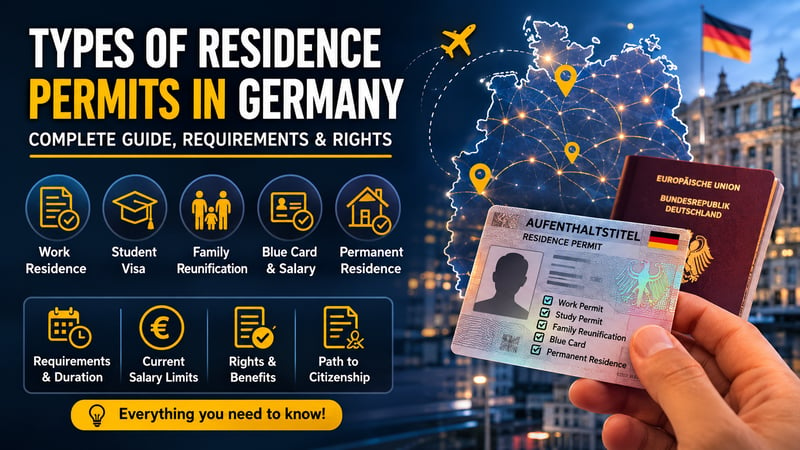
Types of Residence Permits in Germany
Aktualisiert am Jul 5, 2026
Sprache des ArtikelsEnglish
A Complete Guide to the Most Important Residence Permits, Requirements, Rights, and the Path to Permanent Residency
⸻
Introduction
Germany is one of the most important immigration destinations in Europe, and every year hundreds of thousands of people from all over the world try to immigrate to this country.
Immigrants in Germany come from many different backgrounds, and the German Foreign Office has established special conditions for each of these groups.
In this article, we have tried to briefly explain the types of visas issued by German embassies and the different types of residence permits available in Germany.
This is important because in Germany, your residence status is not just a simple “residence card.” It directly affects many aspects of your life, including:
* work authorization,
* stability and security of residence,
* the possibility of extension,
* travel rights,
* the ability to bring family members,
* obtaining permanent residency,
* and even receiving a German passport.
For this reason, understanding the different types of residence permits in Germany is essential for every immigrant.
⸻
The Difference Between a Visa and a Residence Permit
Many people believe that a “visa” and a “residence permit” mean the same thing, but in Germany they are completely different.
A visa (Visum) is usually issued before entering Germany and only allows initial entry into the country. After arrival, the person must apply for a residence permit through the German immigration office (Ausländerbehörde).
A residence permit determines:
* how long you may stay in Germany,
* whether you are allowed to work,
* whether you may study,
* and what legal rights you will have.
⸻
Work Residence Permit in Germany
Aufenthaltserlaubnis zur Beschäftigung
One of the most common residence permits in Germany is the work residence permit. This permit is issued to people who:
* have an employment contract,
* have been hired by a German company,
* or possess professional qualifications needed in the German labor market.
To receive this type of residence permit, applicants usually need:
* a valid employment contract,
* sufficient income,
* health insurance,
* and a valid passport.
For some professions, the German Federal Employment Agency (Bundesagentur für Arbeit) must also approve the employment.
⸻
What Is the German Blue Card?
Blue Card
The Blue Card is one of the most important and popular work residence permits in Germany and is specifically designed for highly qualified professionals.
This type of residence permit is especially suitable for:
* engineers,
* software developers,
* doctors,
* IT specialists,
* and university graduates.
⸻
Main Advantages of the Blue Card
Compared to a regular work residence permit, Blue Card holders enjoy additional benefits, including:
✔ Faster path to permanent residency
✔ Easier family reunification
✔ Greater flexibility in the labor market
✔ Higher residence security and status
✔ Easier mobility within the European Union under certain conditions
⸻
What Is the Minimum Salary Requirement for the Blue Card in Germany?
The minimum salary required for the Blue Card changes every year.
In 2025, the minimum gross annual salary was generally announced as approximately:
45,300 euros gross per year
However, for shortage occupations (Mangelberufe) such as:
* computer engineering,
* civil engineering and road construction,
* mathematics,
* sciences,
* medicine,
people with an annual gross salary of approximately:
41,000 euros gross per year
may also qualify for the Blue Card.
Please note: The requirements for obtaining a Blue Card may change every year.
⸻
Student Residence Permit in Germany
Aufenthaltserlaubnis zum Studium
Germany is one of the most popular countries in the world for international students.
Student residence permits are issued for:
* university studies,
* preparatory college programs,
* language courses,
* or certain specialized training programs.
⸻
Common Requirements for Student Residence
Students are usually required to provide:
* a letter of admission,
* proof of sufficient financial resources,
* health insurance,
* and proof of accommodation.
⸻
Blocked Account (Sperrkonto)
Many international students must open a blocked account (Sperrkonto).
In recent years, the required amount has generally been more than:
12,000 euros
for one year of living expenses.
⸻
Student Work Permission
International students in Germany are generally allowed to work:
* 120 full days
or
* 240 half days
per year.
⸻
Family Residence Permit in Germany
Familiennachzug
This type of residence permit is issued to people whose close family members live in Germany.
The most common cases include:
* joining a spouse,
* children under the age of 18,
* or family members of work permit and Blue Card holders.
⸻
Language Requirement for Spouses
In many cases, spouses must provide proof of German language skills at level A1.
However, some groups, such as Blue Card holders, may benefit from exceptions.
⸻
Permanent Residence in Germany
Niederlassungserlaubnis
Permanent residence is one of the most important goals for immigrants in Germany.
A person with permanent residence:
* has no time limitation on their stay,
* enjoys greater work freedom,
* and has stronger residence security.
⸻
Common Requirements for Permanent Residence
Applicants usually must:
* have lived legally in Germany for several years,
* have paid into the pension insurance system,
* know the German language,
* have sufficient income,
* and have no serious criminal record.
⸻
German Citizenship
Einbürgerung
Citizenship is a higher legal status than permanent residence.
After receiving citizenship, a person:
* receives a German passport,
* gains voting rights,
* and officially becomes a German citizen.
⸻
Requirements for Citizenship
The requirements usually include:
* several years of legal residence,
* at least B1-level German language skills,
* financial independence,
* passing the citizenship test,
* and no serious criminal record.
⸻
What Is Duldung?
Duldung
Duldung means “tolerated stay” and is not considered a real residence permit.
This status is usually issued when:
* deportation is currently not possible,
but
* the person has not yet received official residence status.
⸻
Important Note
People with Duldung usually:
* have less residence security,
* face more work restrictions,
* and live in a temporary and uncertain situation.
⸻
The Impact of Criminal Offenses on Residence Status
In Germany, certain criminal offenses can seriously affect immigration status.
For example:
* drug-related crimes,
* violence,
* theft,
* use of forged documents,
* or cybercrime
may lead to:
* rejection of residence permit extensions,
* problems obtaining permanent residence,
* difficulties with citizenship,
* or even deportation.
⸻
Final Conclusion
To build a secure future in Germany:
✔ Understand your residence status carefully
✔ Take immigration laws seriously
✔ Always provide real and accurate documents
✔ Monitor your residence status regularly
✔ Stay away from crimes and legal problems
In Germany, residence status plays a major role in a person’s professional, financial, and social future.
⸻
✔ Awareness
✔ Planning
✔ Respect for the law
These three principles are the foundation of successful immigration and legal life in Germany.